

Sync Nuvia data into your data warehouse
Erathos' Nuvia connector extracts data from conversations, contacts, campaigns, agents, messages, inboxes, knowledge base, and custom tables directly to your data warehouse. With incremental synchronization for conversations and tables, you keep your data always up to date without overloading the API. No code to write or maintain.
No credit card required. Upgrade whenever you want.
Trusted by great companies












Move data in a few clicks

Connect your source
Authenticate your account and you're done. 100+ ready-made connectors, no code required.
Configure the sync
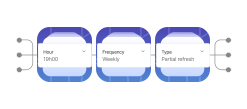
Pick the tables, the schedule and the update type: batch, cursor-based incremental or CDC.

Choose your destination
Load into BigQuery, Redshift, Databricks, PostgreSQL, ClickHouse, Amazon S3 and more.
Nuvia


Consolidate data from multiple sources into a single repository
Erathos is a complete ELT platform that extracts data from Nuvia and over 100 other sources via instant integrations. With plug-and-play connectors, you can centralize all your data in a single analytical environment and build a Data Warehouse in minutes.
Data in your data warehouse in minutes
Plug and play connectors
Chats and tables sync incrementally, reducing API consumption and keeping your data fresh without reprocessing historical records.
Learn moreFull-stack observability
Every pipeline run is monitored with detailed logs, performance metrics, and automatic alerts via email, Slack, or Discord in case of failures.
Learn moreNo-code setup
Just provide your Nuvia API token. Erathos automatically handles pagination, rate limits, retries, schema evolution, and backfills.
Learn moreBuilding data-driven stories
“Every new source implementation, if I had to do it myself, would take about two or three months. With Erathos, it's done in a few hours. I don't need the skills of a data engineer to generate real value from the company's data.”


“Erathos revolutionized data management at WE. By integrating multiple SaaS tools into a single DW, our technical team now focuses on the core business. We implemented dashboards with insights across every area, enriching our organizational culture and improving our decision-making.”


“We used to have a lot of rework, and now we don't. It's more efficient to work this way. If it's not your core business, hire Erathos. Spend your time modeling your own domain, not someone else's.”

“If I didn't have this infrastructure, I'd need three or four people to do what Erathos does today. I was able to generate real value from my data with a much leaner setup than I thought I'd need. That's the core of building a data-driven culture: the team only uses data when they can trust it.”

“Erathos brought a practical turnaround at CCM. We were able to integrate financial systems, CRM, and processes with BigQuery in just a few clicks, with no technical team required. That gave us a reliable data warehouse that powers automations, dashboards, and even our customer service bots.”


“The robustness and efficiency of Erathos's connectors — whether for Meta, Google, RD Station, or ERPs like Bling and Conta Azul — make the whole process much faster and more reliable. The technical documentation is extremely well put together and intuitive, which makes implementation much easier.”












Nuvia Connector FAQ
The connector syncs agents, campaigns, campaign_enrollments, contacts, conversations, messages, inboxes, knowledge, tables, and table_rows. Conversations and tables support incremental sync.
For the conversations and tables endpoints, Erathos uses cursors (createdAt and updatedAt, respectively) to fetch only new or modified records since the last run, reducing sync time and costs.
Yes. You can try the Nuvia connector for 14 days free, no credit card required. Just create an Erathos account and connect your API token.
Nuvia's data can be delivered to BigQuery, Redshift, PostgreSQL, Databricks, Amazon S3, Azure SQL Server, Clickhouse, and Supabase.
No. Erathos is an ELT platform that extracts data from Nuvia and delivers it to your data warehouse. Transformations and integrations between systems are managed by your data team, typically using dbt.