Melhores Ferramentas ELT em 2026: Fivetran, Airbyte
Compare as melhores ferramentas ELT em 2026: Erathos, Fivetran, Airbyte, Estuary, Weld e mais, com preço, conectores e melhor uso.
ELT tools move data from your sources (databases, CRMs, ERPs, ad platforms) into a data warehouse, where you transform it with SQL. This guide compares the main options in 2026 with current pricing from each vendor's own pages, so you can pick based on your sources, volume, and budget.
This article covers ELT in data engineering (Extract, Load, Transform). If you searched for ELT as in English Language Teaching, this is the wrong page.
What is an ELT tool?
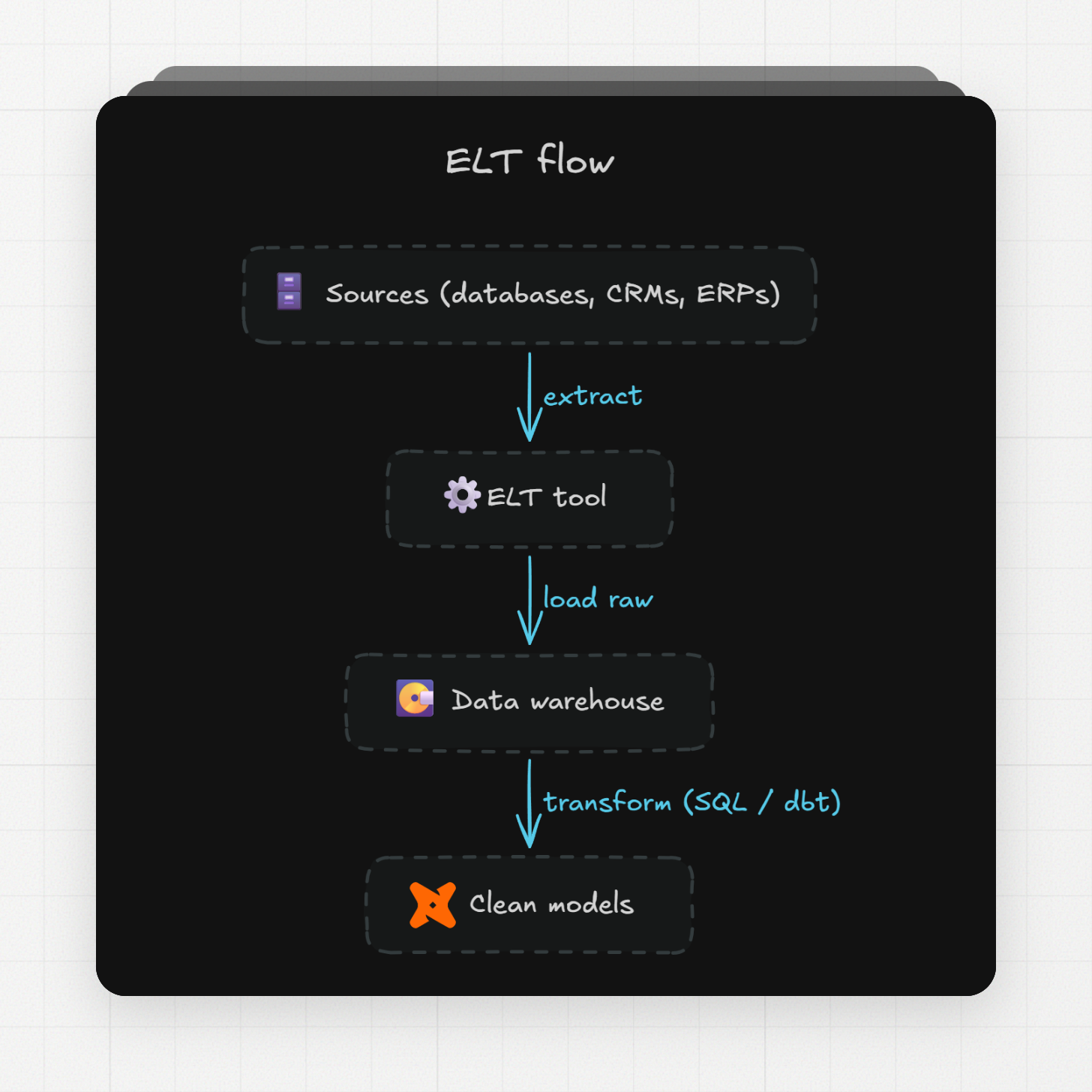
An ELT tool extracts data from source systems, loads it raw into a destination like a data warehouse, and leaves transformation for later, inside that destination. Load first, then transform where the data lands.
This is the reverse of classic ETL, where data gets transformed before it is loaded. ELT became the default pattern with cloud warehouses like Snowflake, BigQuery, and Databricks, because those engines are cheap and fast enough to run transformations on raw data at scale. The ELT tool only has to do two jobs well: connect to many sources and write rows to the warehouse without losing or duplicating anything.
In practice a stack has two layers. An ELT tool like Erathos handles extract and load. A transformation tool, usually dbt, turns the raw tables into clean models. Some products bundle both, and this guide flags which ones do.
ELT vs. ETL: what is the difference?
ETL transforms data before loading it into the destination. ELT loads raw data first and transforms it inside the warehouse. The letters are the same. The order and the place where transformation runs are what change.
ETL | ELT | |
|---|---|---|
Order | Extract, transform, then load | Extract, load, then transform |
Where transforms run | A processing server between source and destination | Inside the destination warehouse |
Raw data in the warehouse | No, only transformed data arrives | Yes, raw tables land first |
Good for | Masking or dropping sensitive fields before load | Fast loading, flexible remodeling later |
ETL still has a real use case: when compliance requires you to mask or omit sensitive information before it ever reaches the warehouse. For everything else, loading raw and transforming in SQL is simpler, because you keep the original data and can rebuild any model without re-extracting.
Best ELT tools in 2026: comparison table
The table below lists each tool's deployment model, pricing basis, published entry point, and connector count as claimed on the vendor's own site. Connector counts are vendor claims, and a big catalog says nothing about how deep any single connector goes.
Tool | Deployment | Pricing basis | Published entry point | Connectors (vendor claim) | Best fit |
|---|---|---|---|---|---|
Managed SaaS | Rows written/month | Free up to 1M rows/mo; paid from $29/mo | 139 | Managed pipelines with strong CRM, ERP, and finance coverage | |
Managed SaaS | Monthly active rows (MAR) | Free up to 500k MAR/mo | 700+ | The broadest managed connector catalog | |
Open source + managed cloud | Volume (Standard) or Data Workers (Pro) | Core is free, self-hosted | 600+ | Self-hosting and connector customization | |
Managed SaaS | GB moved + connector instances | Free up to 10 GB/mo; then $0.50/GB + $100/connector | 200+ | Real-time CDC and streaming | |
Managed SaaS | Subscription with MAR and connector limits | $99/mo (billed annually) | 2 to 10+ per plan | ELT, transforms, and reverse ETL in one product | |
SaaS, hybrid on Scale | Credits (task hours + users) | Not published | Not published | Visual low-code pipeline building | |
Managed SaaS | Records/month | $19/mo outside Brazil | Not published | Low-cost no-code pipelines, Brazilian sources | |
Managed SaaS | Rows/month | From $100/mo | 10 Standard sources on entry plan | Simple managed batch ingestion | |
Open source + managed cloud | Compute hours (managed) | Free, self-hosted | 600+ | Git-native, code-first pipelines | |
Open source + cloud | Seats + successful models | dbt Core free; Starter $100/user/mo | Transformation only | The T layer, paired with any tool above |
dbt is in the table because it pairs with any ingestion tool above, but it only transforms. It does not extract or load anything.
Which ELT tool is best for your team?
Fivetran fits teams that want the biggest managed catalog and accept MAR pricing. Airbyte and Meltano fit teams that self-host. Estuary fits streaming CDC. Weld bundles transforms and reverse ETL. Erathos and Kondado fit teams that want managed pipelines at a low entry price, with strong Brazilian and Latin American source coverage.
Your situation | Good fit |
|---|---|
Many SaaS sources, budget for usage pricing | Fivetran |
You want to self-host or modify connectors | Airbyte, Meltano |
You need sub-second or CDC replication | Estuary |
You want ingestion, dbt models, and reverse ETL in one subscription | Weld |
Your sources include Brazilian ERPs, CRMs, or finance tools | Erathos, Kondado |
You want a visual canvas for building pipelines | Matillion |
You want basic managed batch syncs with row pricing | Stitch, Erathos |
You already have ingestion and only need transformation | dbt |
The sections below give the sourced detail behind each row.
Erathos
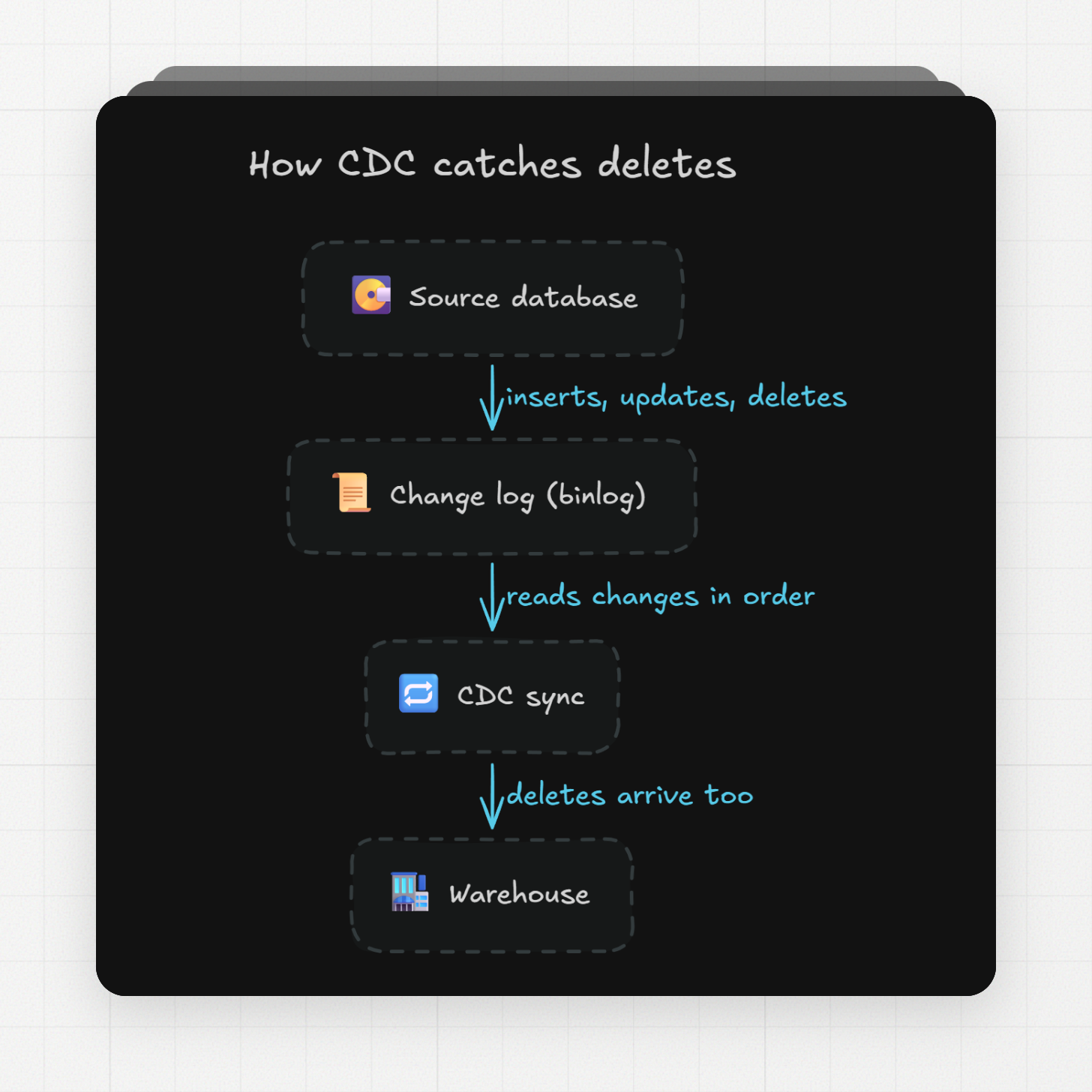
Erathos is a managed ELT platform with 139 listed connectors across CRMs, ERPs, marketing tools, finance systems, and databases, loading into destinations like BigQuery, Databricks, Redshift, ClickHouse, Postgres, SQL Server, and Supabase. Pipelines can run as batch loads, cursor-based incremental loads, or Change Data Capture (CDC), which reads the database's change log to catch inserts, updates, and deletes.
Pricing is by rows written to the warehouse per month. The Freemium plan is free up to 1M rows/month with daily updates. Movement is $29/month for 2M rows/month, 3 users, unlimited pipeline jobs, and hourly updates. Pro is $250/month for 5M rows/month and adds CDC, custom backfills, custom retries, 5-minute updates, and API access. Enterprise goes up to 1.5 billion rows/month. Annual customers pay for 10 months and get 12, and new accounts get Pro access for 14 days.
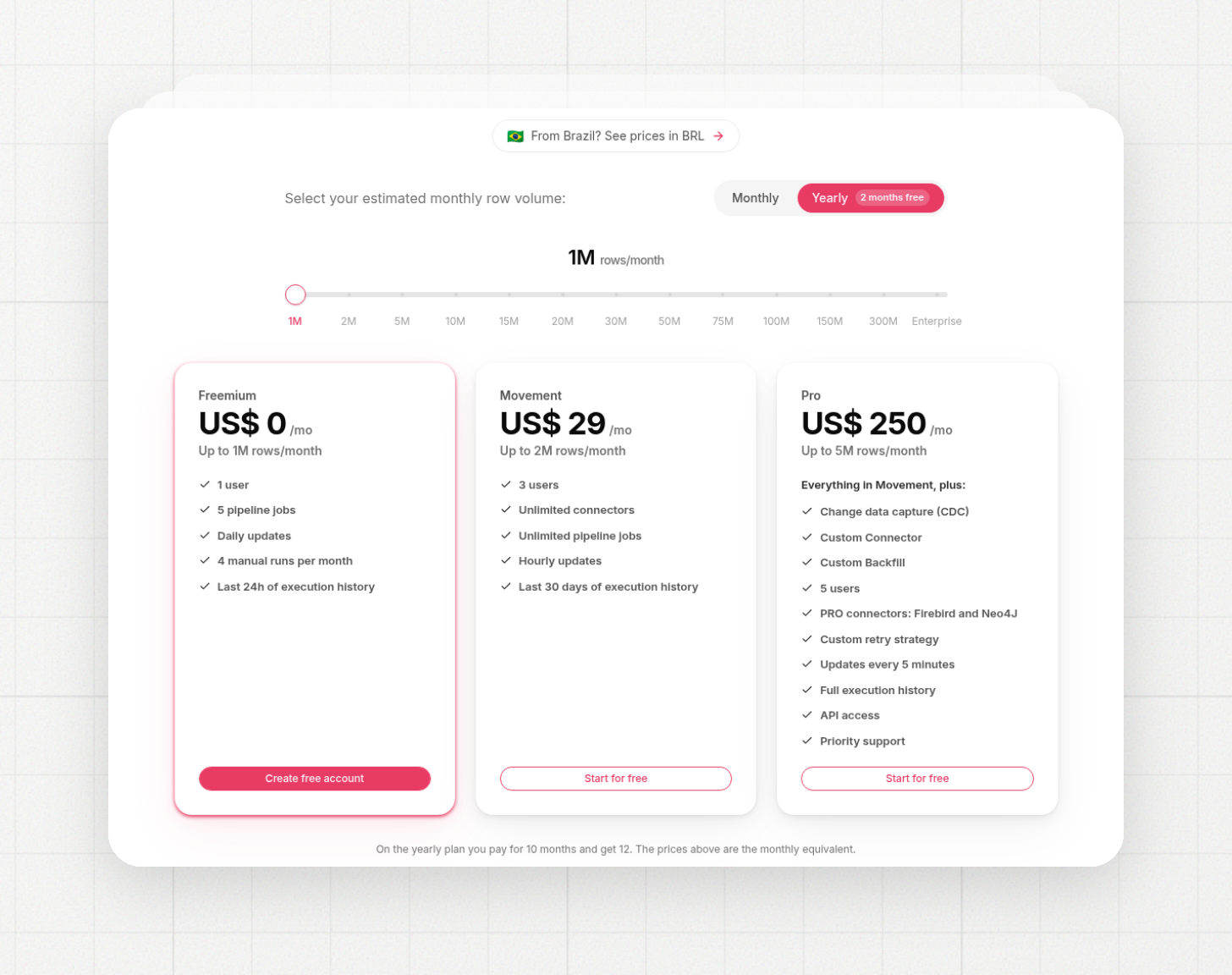
Erathos pricing plans: Freemium, Movement, and Pro
Two capabilities stand out against the bigger catalogs. Schedules can be set per endpoint or per table, so a heavy table can sync hourly while the rest of the connection syncs daily, and backfills reprocess a specific date range by adjusting the run cursor. And when a source has no built-in connector, a custom connector builds from a GitHub repository: each push rebuilds the connector image, and after the first successful build it works like any built-in connector.
For monitoring, the runs view records status, duration, and processed volume for each execution, and alerts go to Slack, Discord, or email with the job and error context. You can rerun or mute a job from the notification itself.
Erathos lists 139 connectors against Fivetran's 700+, so if your stack leans on long-tail US SaaS tools, check the connector list first.
Fivetran
Fivetran is the largest managed ELT catalog, with 700+ fully managed connectors and 15-minute syncs on the Standard plan. The free tier includes 500,000 monthly active rows.
Pricing is per monthly active row (MAR): a row counts once per month when it is inserted or updated, unchanged rows and initial syncs are excluded. Two changes took effect on January 1, 2026: deletes now count toward paid MAR (repeated deletes of the same row in a month count once), and each Standard connection producing between 1 and 1 million MAR gets a $5 base charge. Fivetran's own pricing example for four connectors on Standard totals $549.36/month.
MAR pricing means a busy transactional database can cost far more than a marketing API that moves the same number of tables. The per-connection minimum also adds up for teams with many small sources. The catalog size and the 15-minute syncs make it a good pick for teams with lots of SaaS sources and the budget to match.
Airbyte
Airbyte is the main open-source option, with 600+ connectors. Airbyte Core is free and self-hosted. The managed plans split by how they bill: Standard is fully managed and volume-based, while Pro bills on capacity through Data Workers, and each Data Worker typically runs about 3 syncs at the same time. Enterprise Flex adds in-boundary deployment, including on-premises, multi-region, and a hybrid model where Airbyte manages the control plane.
The pricing page does not publish dollar rates for the managed ingestion plans, so budgeting means talking to sales or starting from the self-hosted version and measuring your own infrastructure cost.
Airbyte makes sense when you want to own the deployment, modify connectors, or keep data inside your own network boundary. That control comes at a cost. On Core, you run the infrastructure, upgrades, and monitoring yourself.
Estuary
Estuary moves data in real time or batch, with CDC as its main strength and 200+ managed connectors. The paid plan advertises millisecond latency or batch on the same platform.
The free Developer tier includes 10 GB/month and 2 concurrent connector instances. Cloud pricing is $0.50 per GB moved plus $100/month per connector instance for the first 6 instances, then $50/month for each one after that. Private and BYOC (bring your own cloud) deployments are Enterprise only, on annual contracts.
GB-based pricing rewards wide rows and punishes chatty small ones, the opposite profile of row-based billing. If you need streaming freshness, Estuary is built for exactly that. If daily or hourly batch is enough, the per-connector charge makes small stacks pricier than row-based tools.
Weld
Weld bundles data movement, transformations with dbt integration, orchestration, and reverse ETL (writing warehouse data back into tools like Google Sheets or ad platforms) into one subscription. Reverse ETL is included on all plans.
Basic is $99/month billed annually with 2 connectors, 1 user, 5M MAR, and daily syncs. Premium is $389/month with 6 connectors, 3 users, 10M MAR, hourly syncs, custom connectors, orchestration, a REST API, and an MCP server (Model Context Protocol, a way for AI assistants to call external tools). Business is $959/month with 10 connectors, 5 users, 50M MAR, and 15-minute syncs. Enterprise adds CDC, 5-minute syncs, and a choice of AWS, GCP, or Azure.
The subscription model makes costs predictable, but watch the connector limits. At 2 to 10 included connectors per plan, a stack with fifteen sources needs the extra-connector fees or the Enterprise tier.
Matillion
Matillion is a low-code pipeline builder: a visual canvas with SQL and Python steps, pre-built and custom connectors, and a built-in Git repository. The Scale edition adds hybrid cloud deployment, streaming CDC pipelines, lineage, and 180+ days of log retention.
Billing is a consumption credit system where credits are consumed by task hours and additional developer users. The pricing page does not publish a per-credit dollar price, so cost planning requires a sales conversation.
Matillion fits teams that want analysts and engineers building pipelines on the same visual canvas, rather than a pure load-and-model workflow.
Kondado
Kondado is a no-code, cloud-managed integration service with a strong Brazilian source catalog. It loads into warehouses, lakes, databases, and spreadsheets, and can also expose data to Claude or ChatGPT through MCP.
For customers outside Brazil, plans start at $19/month for 4 pipelines, daily schedules, and 1 million records/month, where a record is a destination row of up to 500 bytes. Pipelines pause when the monthly record limit is reached, until the next month or an upgrade. Frequencies range from every 5 minutes to weekly depending on plan, and the trial runs 14 days with 10 million records and 30 pipelines, no credit card.
Check the record definition closely. A 2 KB row counts as multiple records, so wide tables consume the quota faster than the row count suggests.
Stitch
Stitch is a managed batch ingestion tool with straightforward row pricing. Standard starts at $100/month, scales from 5 to 300 million rows/month, and includes one destination, 10 Standard sources, 5 users, and 7-day log retention. Advanced is $1,500/month billed annually for 100 million rows/month, and Premium is $3,000/month billed annually for 1 billion rows/month. There is a 14-day free trial without a credit card.
Stitch does the simple thing at a known price. The limits are the single destination and the short log retention on Standard, and there is no CDC story comparable to Estuary or Erathos Pro.
Meltano and dbt: where do open source and transformation fit?
Meltano handles extract and load as code. dbt handles transformation. Neither replaces the other, and dbt is not an ELT tool on its own.
Meltano Open is the self-hosted, open-source version with 600+ connectors and Git-native pipelines, so pipeline definitions live in version control like the rest of your code. The managed Starter, Growth, and Scale plans include 200, 2,000, and 5,000 compute hours per month, counted as time the managed infrastructure spends extracting, loading, or transforming. Prices for the managed plans are not published.
dbt transforms raw tables into clean models with SQL. dbt Core is open source under Apache 2.0. The hosted Developer plan is free with one seat and 3,000 successful models/month; Starter is $100 per user/month with five seats and 15,000 successful models/month. Pair it with any ingestion tool in this list.
How should you compare ELT pricing?
You can't compare ELT tools by monthly totals, because most vendors bill different units. Convert your own workload into a vendor's unit first, then compare.
Tool | What you pay for |
|---|---|
Fivetran | Monthly active rows (inserts, updates, and deletes), plus a $5 minimum per small connection |
Erathos | Rows written to the warehouse per month, by plan tier |
Stitch | Rows per month, by plan tier |
Kondado | Records per month, one record = destination row up to 500 bytes |
Estuary | GB moved plus a monthly fee per connector instance |
Weld | Flat subscription with included MAR, connectors, and users |
Airbyte | Volume on Standard, Data Worker capacity on Pro |
Matillion | Credits consumed by task hours and developer users |
Meltano (managed) | Compute hours spent extracting, loading, or transforming |
The same workload prices very differently across units. A high-churn Postgres table generates MAR on every update, costs little under GB pricing if the rows are small, and burns Kondado records fast if the rows are wide. Estimate with your real tables, since a vendor's example workload rarely matches yours.
What should you test before choosing an ELT tool?
Run a proof of concept with your real sources and a realistic data sample. A connector existing in a catalog says nothing about how it handles your schema, your volume, or your edge cases.
Things to check in a two-week trial:
- Your exact source and destination pair, with your authentication setup
- Schema changes: add a column in the source and watch what happens downstream
- Incremental behavior: does the tool support cursor-based loads or CDC for your source?
- Deletes: a sync that queries the source with SELECT cannot observe a row that was created and deleted between runs. CDC reads the change log and catches it
- Refresh frequency: confirm the plan you'd pay for includes the sync interval you need
- Error visibility: force a failure and see how the tool reports it and how you rerun
- Backfills: reprocess one date range without reloading the whole table
- Volume: run a month of realistic data and check the bill against the pricing unit
CDC also has source-side requirements the trial will expose. For MySQL, binlog CDC needs binary logging in ROW format with full row images and a replication user with the right privileges, which usually means a conversation with whoever owns the production database.
FAQ
Is dbt an ELT tool?
No. dbt only transforms data that is already in the warehouse. It does not extract or load anything. It is the T in ELT and needs an ingestion tool in front of it.
Is SQL an ETL tool?
No. SQL is the language transformations are written in, inside tools like dbt or directly in the warehouse. An ETL or ELT tool is a product that moves data between systems. SQL is one of the things you use once the data has arrived.
Is ETL obsolete?
No. ETL still fits when data must be masked or omitted before it reaches the warehouse, which some privacy and compliance rules require. For most analytics workloads, ELT replaced it because cloud warehouses transform raw data cheaply and keeping the raw tables makes remodeling easier.
What is the best free ELT tool?
For a managed free tier, Fivetran includes 500,000 MAR/month and Erathos includes 1 million rows/month. For self-hosting, Airbyte Core and Meltano Open are free and open source, and you pay with your own infrastructure and operations time.
Try Erathos free for 14 days
New accounts get 14 days of Pro access, with CDC, 5-minute updates, and custom backfills included, and the Freemium plan stays free up to 1M rows/month after that. Try Erathos free for 14 days and run the proof-of-concept checklist above on your own sources.