


GitHub + PostgreSQL
GitHub is the world's leading platform for code hosting, Git-based version control, and software development collaboration. Engineering teams centralize repositories, pull requests, code review, issues, and organization member activity in GitHub, making it the richest source of data on software throughput, quality, and productivity.
In practice, GitHub acts as the operating system for software delivery: from commit to merge, from bug report to closed issue, every engineering productivity signal is recorded there, ready to be combined with product, support, and business data in a data warehouse.
With Erathos, you can integrate GitHub data into PostgreSQL in just a few minutes. Our platform handles the entire data movement process for your analytics environment and lets you combine that data with other sources in your Data Warehouse. That way, your time goes toward what really creates value—extracting actionable insights and making more data-driven decisions.
No credit card required. Upgrade whenever you want.
Trusted by great companies













Move data in a few clicks

Connect your source
Authenticate your account and you're done. 100+ ready-made connectors, no code required.
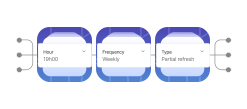
Configure the sync
Pick the tables, the schedule and the update type: batch, cursor-based incremental or CDC.

Choose your destination
Load into BigQuery, Redshift, Databricks, PostgreSQL, ClickHouse, Amazon S3 and more.
Which GitHub data does Erathos sync with PostgreSQL?
The integration automatically syncs GitHub's main objects:
- Repositories — name, organization, language, default branch, issue count, and activity dates
- Pull requests — author, reviewers, status, open, closed, and merge dates
- Issues — author, assignees, labels, status, milestone, and dates
- Commits — author, message, date, and repository
- Org members — users, login, roles, and association dates
Why sync GitHub with PostgreSQL?
In PostgreSQL, engineering data lives alongside the rest of the team's analytics stack—useful for closing DORA metrics, combining engineering productivity with product and HR data in the same database, and building operational dashboards without relying on external SaaS.
How it works
Erathos connects to GitHub through the official API and syncs your data incrementally—only new or updated records are processed in each run, keeping pipelines fast and PostgreSQL costs predictable. You choose the sync frequency (from every 5 minutes to daily), the objects to sync, and the target dataset. Each run is logged with full observability: execution time, rows processed, errors with context, and instant alerts via Slack or email if anything goes wrong.
Centralizing GitHub data in PostgreSQL has never been easier.
Erathos is a data ingestion platform for data teams. With the GitHub connector, you can automatically export repositories, pull requests, issues, commits, and organization members to PostgreSQL — centralized engineering data ready to power DORA metrics, measure review bottlenecks, and provide audit-ready evidence for controls.
Data in your data warehouse in minutes
GitHub connector ready to use
Connect GitHub to PostgreSQL and automatically export repositories, pull requests, issues, commits, and org members. Centralized engineering data to power DORA metrics and engineering analytics — without CSVs or scripts.
Learn moreComplete control over your GitHub pipelines
Configure sync frequency and type by table. Erathos uses intelligent UPSERT in PostgreSQL—ensuring data consistency even during reprocessing.
Learn moreEnd-to-end observability
Stop finding out about GitHub failures only after the business team complains. Every run is logged with runtime, rows processed, and error context. Get automatic alerts via Slack, Discord, or email as soon as anything goes off track — so your data stays up to date and ready for analysis.
Learn moreBuilding data-driven stories
“Every new source implementation, if I had to do it myself, would take about two or three months. With Erathos, it's done in a few hours. I don't need the skills of a data engineer to generate real value from the company's data.”


“Erathos revolutionized data management at WE. By integrating multiple SaaS tools into a single DW, our technical team now focuses on the core business. We implemented dashboards with insights across every area, enriching our organizational culture and improving our decision-making.”


“We used to have a lot of rework, and now we don't. It's more efficient to work this way. If it's not your core business, hire Erathos. Spend your time modeling your own domain, not someone else's.”

“If I didn't have this infrastructure, I'd need three or four people to do what Erathos does today. I was able to generate real value from my data with a much leaner setup than I thought I'd need. That's the core of building a data-driven culture: the team only uses data when they can trust it.”

“Erathos brought a practical turnaround at CCM. We were able to integrate financial systems, CRM, and processes with BigQuery in just a few clicks, with no technical team required. That gave us a reliable data warehouse that powers automations, dashboards, and even our customer service bots.”


“The robustness and efficiency of Erathos's connectors — whether for Meta, Google, RD Station, or ERPs like Bling and Conta Azul — make the whole process much faster and more reliable. The technical documentation is extremely well put together and intuitive, which makes implementation much easier.”













Other paths for your data
Other destinations for GitHub


Other sources that land in PostgreSQL
CRMs, ERPs, ad platforms and databases, all through the same managed pipeline.
Frequently Asked Questions
Erathos is a data ingestion platform built for reliability, transparency, and control. We help data teams connect tools like GitHub to their data warehouse—with full observability into every run, zero maintenance, and none of the opacity found in traditional market tools.
Erathos syncs GitHub repositories, pull requests, issues, commits, and organization members to PostgreSQL. Ready-to-use data to build DORA metrics, measure PR lead time, identify review bottlenecks, and surface access controls for auditing.
You can configure the sync frequency from every 5 minutes up to daily, at the table level. Erathos uses incremental synchronization—only new or updated records are processed in each run, keeping the GitHub pipeline efficient and PostgreSQL costs predictable.
Erathos automatically detects failures and sends alerts to your email, Slack, or Discord with full context—not just "job failed." Smart retries handle transient errors, and every execution is logged with run time, processed rows, and error context so your team can debug in minutes, not hours.
Yes. Every Erathos connector includes a 14-day free trial. Connect GitHub to PostgreSQL and start syncing immediately—no credit card required.