Data Movement Platform: What It Is and How to Pick
What a data movement platform is, how it differs from ETL, ELT, CDC and streaming, and how to compare Fivetran, Airbyte, Erathos & more.

Every analytics stack starts with the same job: get data out of the databases and SaaS tools (the software you subscribe to, like a CRM) where it is created and into a warehouse where you can query it. A data movement platform does that job for you, and the market for it is big. Grand View Research puts the data integration market at $17.9 billion in 2025, growing to a projected $47 billion by 2033.
What is a data movement platform?
A data movement platform is software that copies data from source systems (databases, SaaS apps, and ERPs, the systems a company runs its finance and operations on) into destinations, usually a data warehouse, keeps that copy up to date on a schedule or in near real time, and alerts you when a sync fails.
The category covers the full lifecycle: an initial load of historical data, then continuous updates as the source changes, plus handling for schema changes like new columns. IBM defines the underlying job simply: transferring data from one location, system, or environment to another.
In practice, a platform bundles four things you would otherwise build yourself: pre-built connectors, scheduling, loading, and monitoring. The loading step is usually staged. Erathos, for example, extracts data to a temporary cloud bucket (S3, GCS, or Azure Blob Storage), loads it into the warehouse with a bulk copy command, then deletes the temporary files.
How is a data movement platform different from ETL, ELT, CDC, and reverse ETL?
Data movement is the umbrella job. ETL, ELT, CDC, streaming, and reverse ETL are patterns for doing that job, and a data movement platform is the product that runs one or more of them for you.
Here is what each pattern means:
Pattern | What it does |
|---|---|
ETL | Extracts data, transforms it in a separate processing layer, then loads the result. The legacy approach. |
ELT | Loads raw data into the warehouse first, then transforms it there using the warehouse's own compute. |
CDC | Change data capture. Reads the database transaction log and moves only the rows that changed, including deletes. |
Streaming | Processes events as they happen instead of on a schedule. |
Reverse ETL | Moves data from the warehouse back into operational tools like a CRM. |
If the ETL vs ELT split is new to you, we wrote a longer explainer on what ETL is and why ELT replaced it for most warehouse workloads.
When do you need batch, incremental sync, CDC, or streaming?
Batch full refresh works when tables are small and daily freshness is fine. Cursor-based incremental sync works when the source has a reliable date column. Log-based CDC is for when you need deletes and row-level history. Streaming is for when events must arrive as they happen.
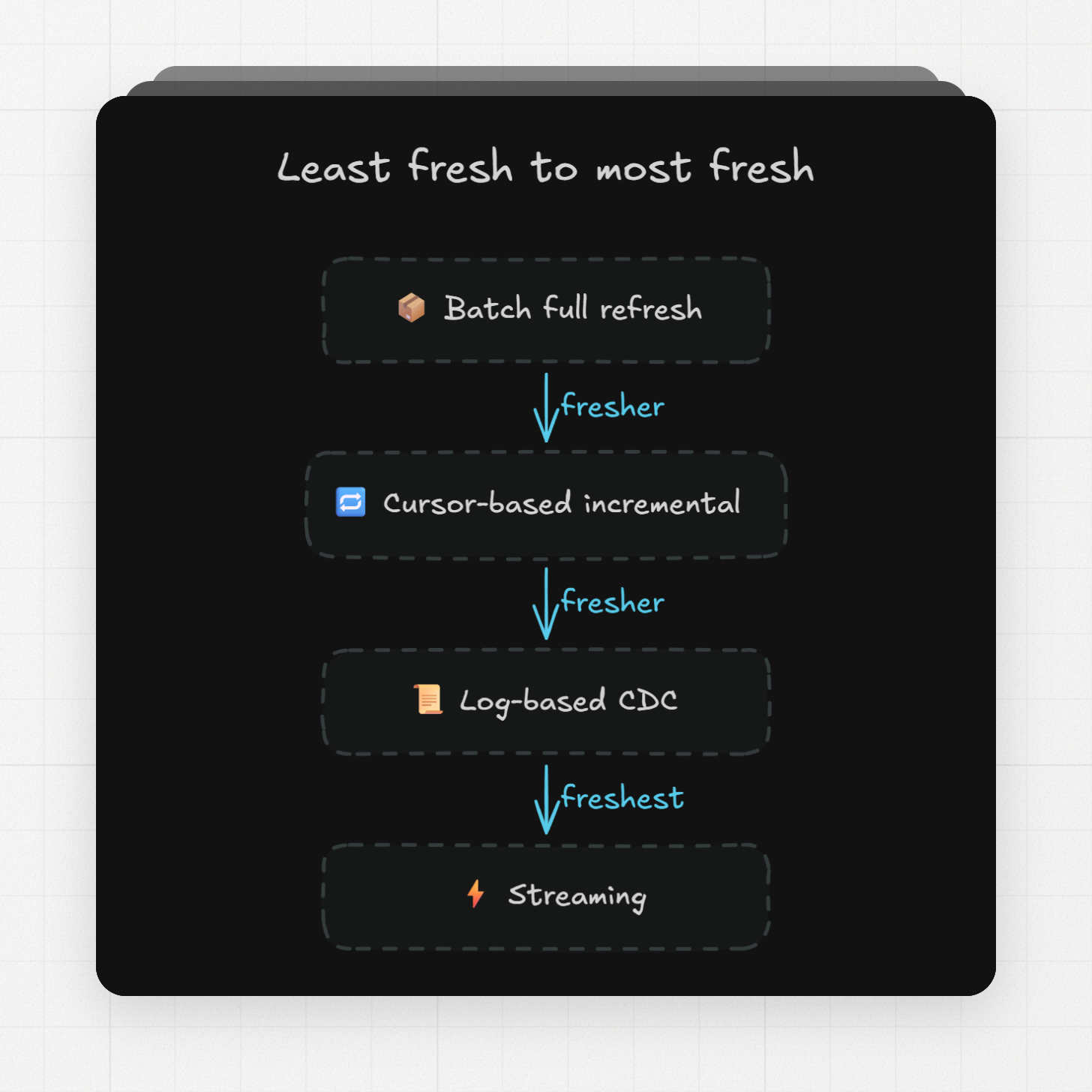
Freshness is the deciding variable. Batch stays appropriate for most analytical workloads where daily or hourly updates are enough, and it is the cheapest pattern to run and debug.
Cursor-based incremental sync has prerequisites: the table needs a primary key and a date or datetime column to serve as the cursor. It also has a blind spot. A row deleted at the source never gets a new cursor value, so the destination keeps it.
CDC fixes that by reading the database's own transaction log (the binlog in MySQL), which records inserts, updates, and deletes. In ELT platforms, CDC is still scheduled log reading. Airbyte's docs say directly that it does not treat CDC sources as infinite streaming sources; syncs run on an interval. The same applies to Erathos, where the Pro plan reads change logs every 5 minutes. For true event-by-event processing you need a streaming platform like Estuary.
What should you compare when choosing a data movement platform?
Compare five things: connector coverage for your exact source-to-destination pairs, update semantics (deletes and schema changes), the pricing meter and how predictable it is, deployment and data residency, and what you can see when a sync fails.
Connector coverage sounds simple but the check is specific: you need your source AND your destination in the same catalog, and you need the sync mode you want on that exact pair. Erathos publishes its catalog as source-to-destination pipelines, which makes this check direct: 1,290 listed pairs, each marked available, beta, or coming soon.
Update semantics hide the sharpest edges. Airbyte's CDC only supports incremental sync for tables with primary keys on most sources. Fivetran counts MAR separately per connection, so syncing one source to two destinations bills the same rows twice.
Observability decides how bad a failure gets. Look for per-run history and alerting. Erathos records status, volume processed, errors, duration, and retries for each run and sends alerts to Slack, Discord, or email when a job fails.
How do the main data movement platforms compare in 2026?
Fivetran, Airbyte, Matillion, Estuary, Informatica, and Erathos all move data from sources to warehouses, but they differ on pricing meter, deployment, and how fresh the data can be. The table below uses only numbers each vendor publishes.
Platform | Connectors (published) | Pricing model | Deployment | CDC | Fastest sync (published) |
|---|---|---|---|---|---|
700+ | Monthly active rows (MAR), billed per connection | SaaS; hybrid option on Enterprise | Yes, on database connectors | 15 min (Standard), 1 min (Enterprise) | |
600+ | Volume-based (Standard) or capacity-based Data Workers (Pro) | Cloud, self-hosted open source, on-prem/hybrid (Enterprise Flex) | Yes, log-based, scheduled | Under 5 min (self-hosted Core), 15 min (Pro) | |
Not published | Consumption credits tied to task hours | SaaS; hybrid on Scale | Streaming CDC on Scale | Not published | |
Hundreds | $0.50/GB plus $100/month for first 6 connectors, $50/month each after | Hosted; private/BYOC on annual plans | Yes, real-time | Real-time streaming | |
Hundreds | Consumption-based, rates not published | Cloud ETL/ELT, Spark, or serverless | Yes, via Cloud Mass Ingestion | Not published | |
139 | Rows written to the warehouse; $0 to 1M rows, $29/mo to 2M, $250/mo to 5M | Managed SaaS | Yes, log-based, on Pro | 5 min (Pro) |
Two warnings about reading this table. Connector counts come from each vendor's own pages and count different things, so a bigger number does not mean your source is covered. And the pricing meters measure different units (rows changed, GB moved, compute hours), so the only way to compare cost is to price your own workload on each meter.
How does Fivetran's MAR pricing work?
Fivetran bills on monthly active rows: the number of distinct rows synced from source to destination in a calendar month. Inserts, updates, and deletes all count, and MAR is counted separately by account, destination, connection, and table.
Three mechanics matter when you model a Fivetran invoice:
- Every changed row counts, so a table where rows update often can cost more than a much bigger table that rarely changes.
- Connections count separately. The same source synced to two destinations doubles the MAR for those rows.
- There is a $5 base charge on any standard connection with usage between 1 MAR and 1M MAR, so many small connections add up on their own.
The free plan covers 500,000 connection MAR per month, which is enough to test real workloads before committing. Running your real sources for a month and reading the usage report beats any estimate, because on update-heavy tables estimates and invoices can drift far apart.
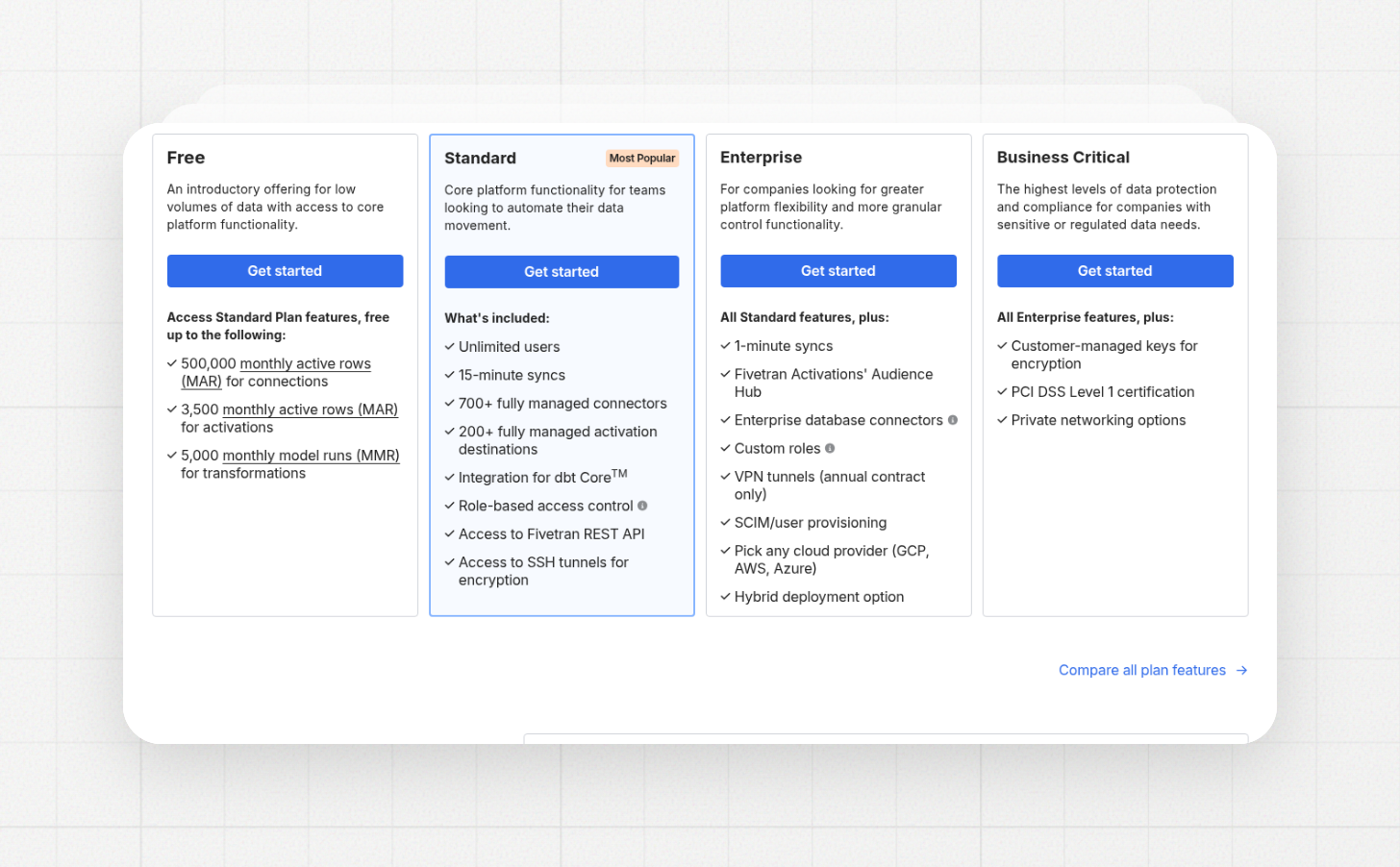
Fivetran's plan tiers: sync frequency and features change by tier, but all bill on MAR
Which platform fits your use case?
There is no single best data movement platform. The fit depends on your deployment needs, your sources, and how you want to be billed.
- Fully managed ELT with the widest managed catalog: Fivetran, 700+ connectors, if your workload prices well under MAR.
- Open source or self-hosted inside your own network: Airbyte Core, with Enterprise Flex when you need a managed control plane over your own data plane.
- Real-time streaming and batch in one platform: Estuary, priced per GB moved.
- Credit-based SaaS with hybrid agents and transformation in the same tool: Matillion.
- Broad enterprise integration (ETL, ELT, Spark, replication) under one vendor: Informatica.
- Flat, row-based plans you can forecast: Erathos, from a free tier at 1M rows/month to Enterprise at 1.5 billion rows/month, with 139 connectors across CRMs, ERPs, databases, and finance tools.
What should a data movement platform proof of concept test?
A useful proof of concept tests one real source-to-destination path end to end: initial load, ongoing changes, a schema change, a failure, and the projected invoice. Feature pages cannot answer those questions; a week with your own data can.
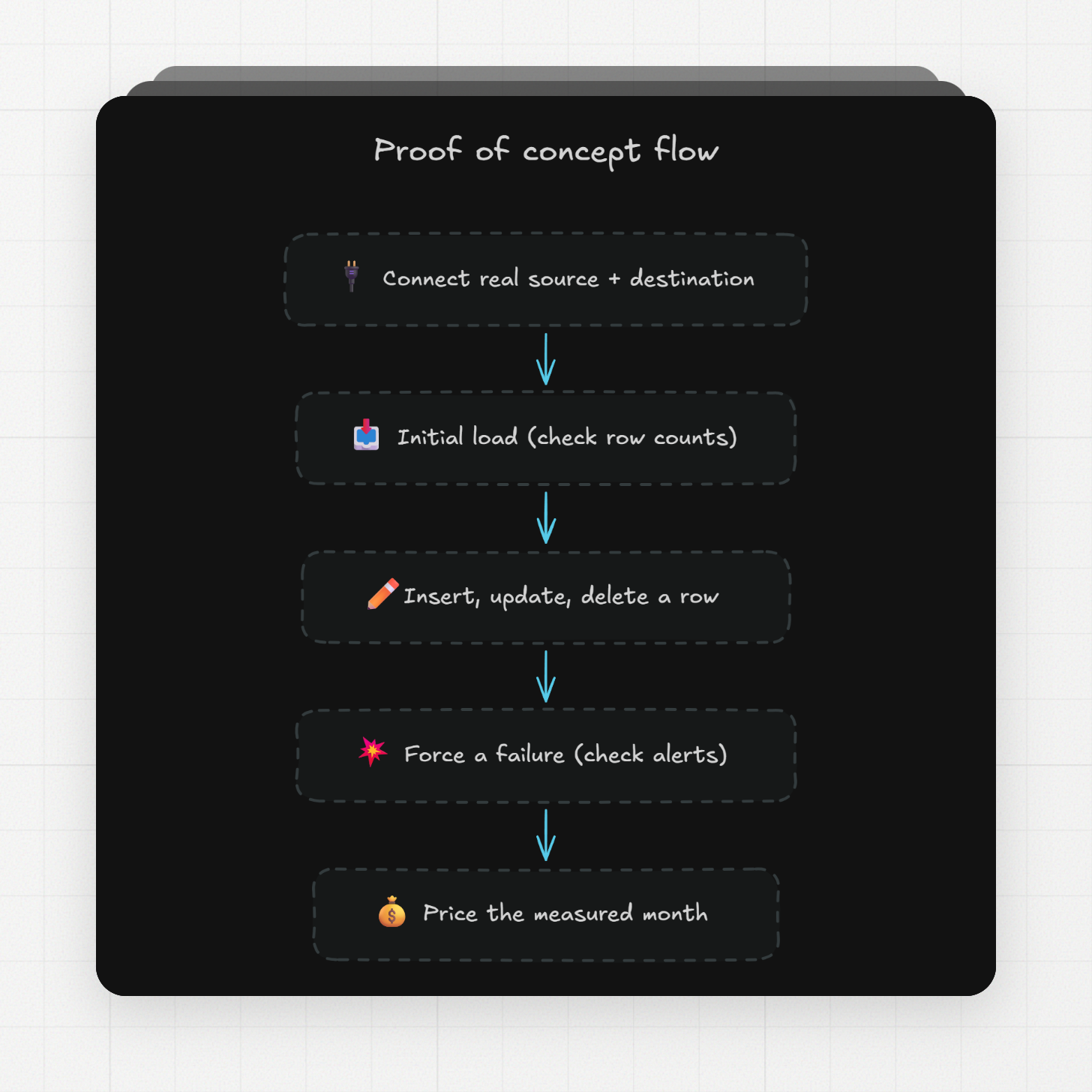
The checklist:
- Connect a real source and your real destination. If the pair is missing from the catalog, stop here.
- Run the initial load and check row counts against the source.
- Insert a row, update a row, and delete a row at the source. Check all three arrive. Cursor-based syncs can fail silently on deletes.
- Add a column at the source and watch what happens. Some platforms replicate schema changes automatically; Airbyte's CDC needs a schema refresh for new columns on some sources.
- Break something (revoke a permission, drop the network) and check how the failure shows up: run history, error detail, and whether anyone gets alerted.
- Measure end-to-end delay from a source change to a queryable row in the warehouse.
- Price the observed month of work under the vendor's meter, using measured rows, GB, or task hours.
If the source is a database and you want CDC, check the prerequisites before the trial starts. For MySQL, log-based CDC needs the binlog in row format with full row images:
# my.cnf settings Erathos MySQL CDC checks for
binlog_format = ROW
binlog_row_image = FULLbinlog_expire_logs_seconds = 864000
The full requirements are in the Erathos MySQL connector docs, and there is a worked example of the whole path in our MySQL CDC to BigQuery guide.
Pricing surprises are the last thing to test. During an Erathos trial, the platform estimates your monthly usage from the trial's runs and emails you if the forecast goes over your plan's limit, so the plan you pick matches the volume you measured.
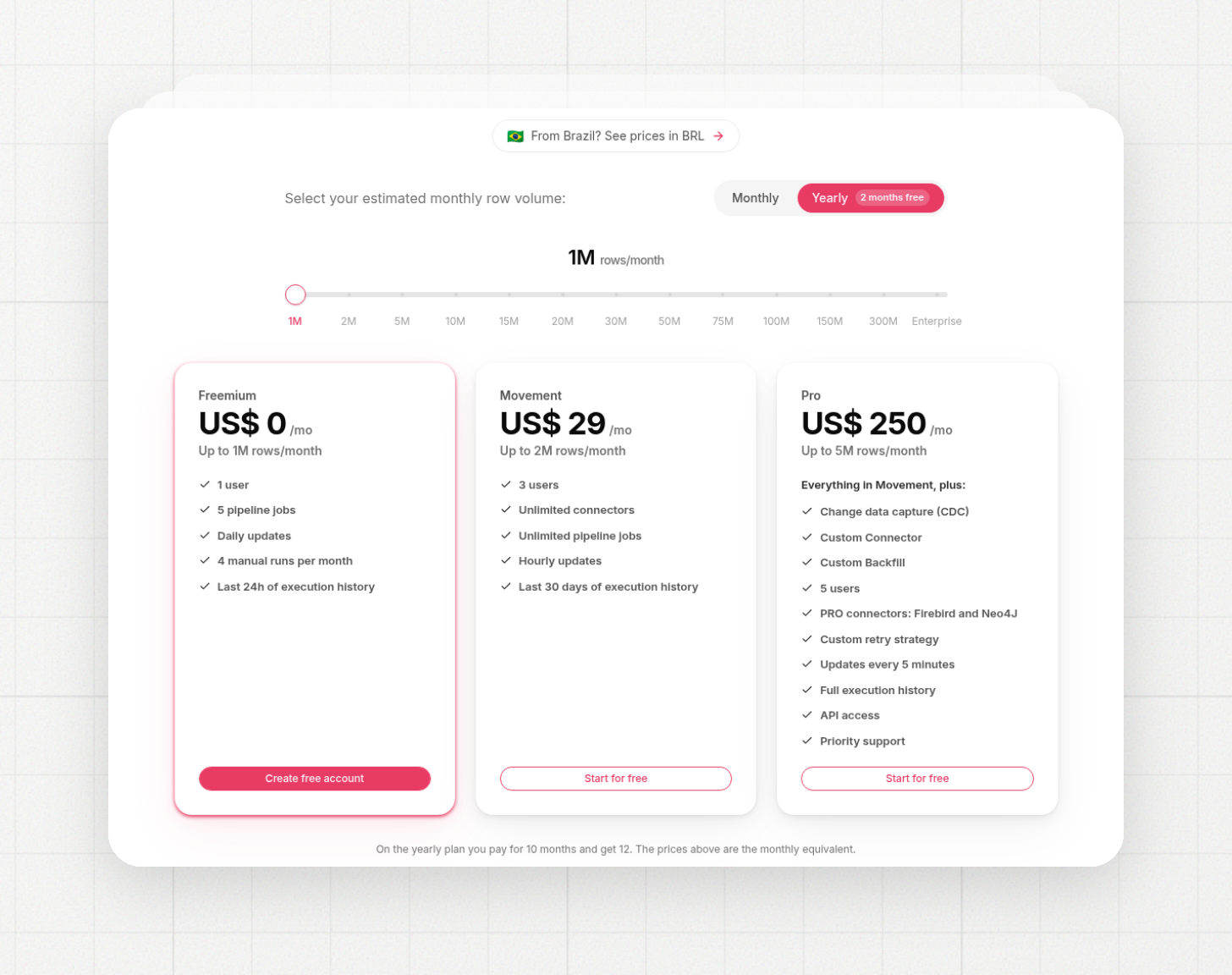
Erathos pricing plans: flat monthly prices tied to rows written per month
Ready to run this proof of concept on your own data? Try Erathos free for 14 days.