Data Lake vs Data Warehouse: Key Differences Explained
The real differences between data lakes and data warehouses in 2026: schema, pricing, users, and where lakehouses fit.
What is the difference between a data lake and a data warehouse?
A data lake stores raw data in its original format and applies structure only when someone reads it. A data warehouse stores data that has already been cleaned and modeled, and it answers SQL queries for reports and dashboards.
A lake accepts structured, semi-structured, and unstructured data without any change before saving. Raw JSON events from an app or readings from IoT sensors are typical lake data. A warehouse holds a curated version of that data: cleaned sales tables, joined and modeled, ready for a dashboard.
The processing order differs too. Data usually goes through cleaning and structuring before it enters a warehouse, while a lake stores first and lets you process later, or never.
How do schema, data types, users, and performance compare?
A lake is schema-on-read, cheap to store, and code-first. A warehouse is schema-on-write, pricier per terabyte, and built for fast SQL. Here is the standard comparison:
Dimension | Data lake | Data warehouse |
|---|---|---|
Schema | Schema-on-read: structure applied when you query | Schema-on-write: structure defined before loading |
Data | Raw: structured, semi-structured, unstructured | Processed and modeled, mostly relational |
Typical users | Data engineers, data scientists | Analysts, business intelligence (BI) teams |
Workloads | Machine learning, exploration, streaming | Dashboards, reports, governed metrics |
Storage cost | Low (object storage) | Higher per terabyte |
SQL performance | Depends on engine, file layout, and partitioning | Fast, the whole system is tuned for it |
These rows describe how each system is usually run, and none of them is a hard product limit. AWS's own comparison says a warehouse schema can be schema-on-write or schema-on-read, and modern warehouses load semi-structured data like JSON without trouble. The real differences in practice are who queries the system, how governed the data is, and what the bill measures.
AWS's own data warehouse vs data lake comparison table
Is Amazon S3 a data lake?
Amazon S3 on its own is object storage. It becomes a data lake when you add the pieces around it: ingestion pipelines, a table format or catalog, a query engine, and security and governance. A bucket full of files with none of that is just a bucket full of files.
A concrete version of that stack: Erathos loads source data into S3 as Parquet files in Iceberg tables, with automatic partitioning and schema evolution. Athena, Spark, Trino, or any other query engine can then read those tables. The storage is plain S3; the table format and the pipeline are what make it a lake.
When should you use a data lake, a data warehouse, or both?
A lake fits when you have lots of raw, varied data and want to explore it with code or train models on it. A warehouse fits when you have specific business questions and want fast reports.
In the common combined pattern, all data lands in a data lake first and then loads into warehouses and marts for specific use cases. The lake keeps the cheap, complete, raw history. The warehouse gets the curated subset that analysts query every day.
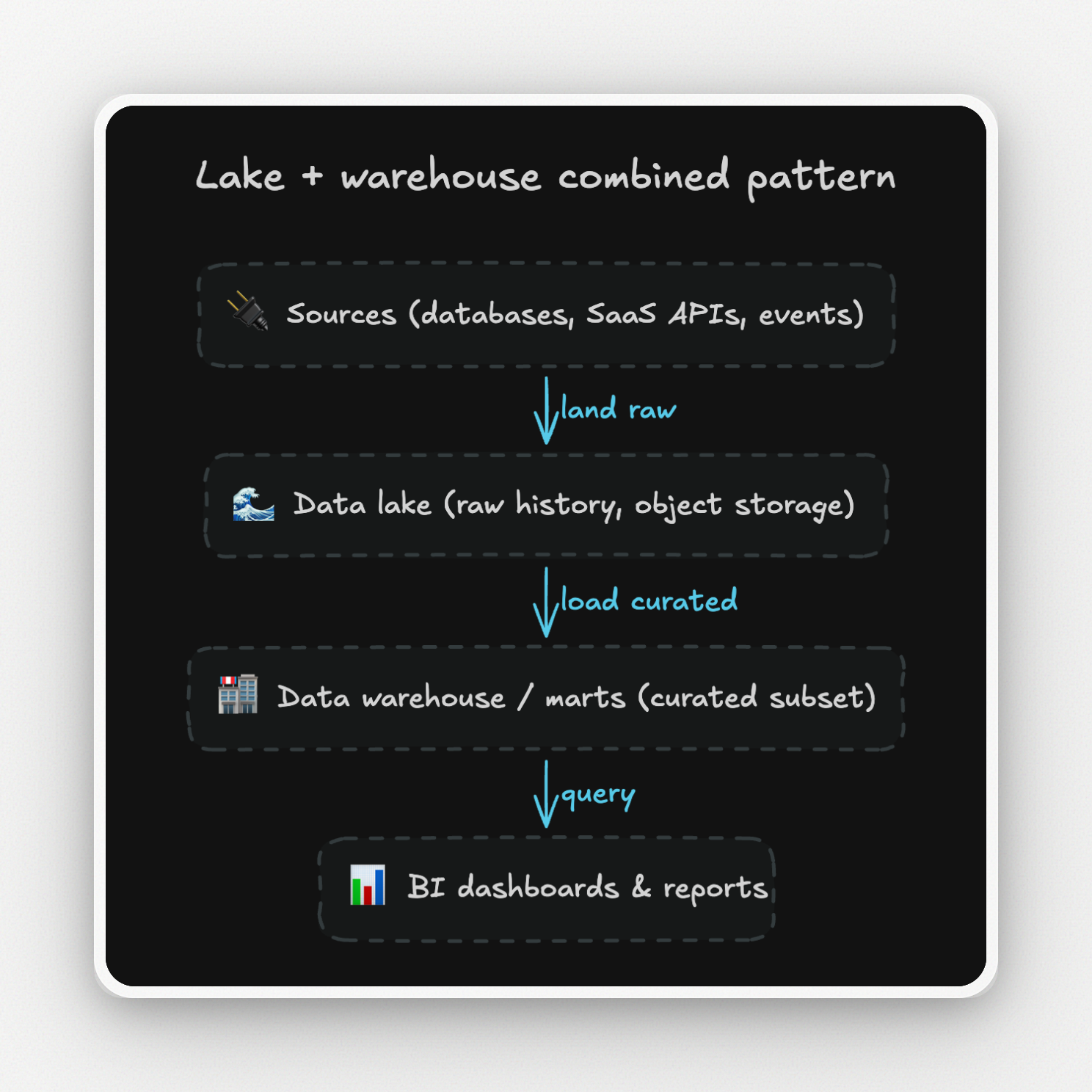
Skipping the lake is fine when your sources are already structured (databases, SaaS APIs) and your only consumers are BI dashboards. Skipping the warehouse is harder to pull off, because analysts want fast, governed SQL, and that is exactly what a lakehouse setup tries to give them.
How much do data lakes and data warehouses cost?
A lake bills mostly for object storage and requests. A warehouse bills for compute (credits, slot-hours, or node-hours) plus storage after compression. The meters measure different things, so the numbers below can be compared in spirit but never summed:
Platform | Meter | List price |
|---|---|---|
Amazon S3 Tables | Storage | |
Amazon S3 Tables | GET requests | |
BigQuery (on-demand) | Data scanned by queries | |
BigQuery | Active logical storage | |
Snowflake (Standard) | Compute credits | |
Snowflake | On-demand storage | |
Redshift Serverless | Compute time | |
Redshift | Managed storage |
Storage in a lake costs about the same as managed warehouse storage per gigabyte now, so raw storage price alone rarely decides the architecture. Compute is where the bills diverge: BigQuery charges by bytes scanned, so partitioning and clustering directly cut query cost, while Snowflake and Redshift charge for compute time, so warehouse size and runtime drive the bill.
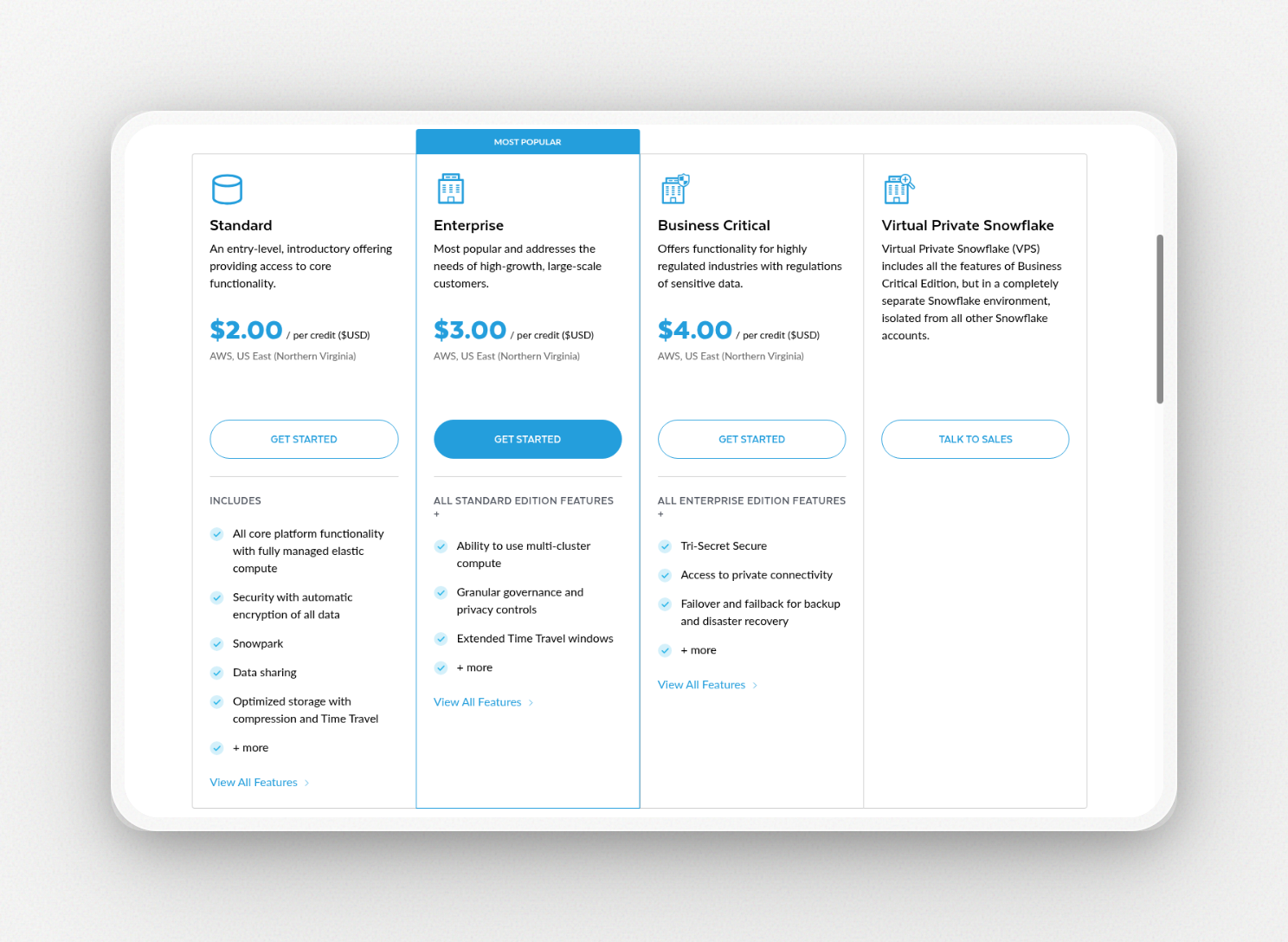
Snowflake's per-credit list prices for AWS US East (N. Virginia)
What is a lakehouse, and how does it change the decision?
A lakehouse gives you warehouse features on files in object storage: transactions, schema enforcement, and fast SQL over the same cheap storage a lake uses. It does this through an open table format, a metadata layer that tracks which files belong to which version of a table.
The two main table formats:
- Delta Lake extends Parquet files with a file-based transaction log. That log gives the tables ACID transactions (atomic, consistent, isolated, durable: a write fully happens or not at all), schema validation on write, and time travel. It is the default format on Databricks.
- Apache Iceberg is an engine-neutral table format. Spark, Trino, Flink, Presto, and Hive can work with the same Iceberg tables at the same time, and schema changes never require rewriting the table.

A table format alone is a spec, and a working lakehouse still needs a catalog, a query engine, and pipelines feeding it. Loading data into one looks the same as loading a warehouse: Erathos, for example, writes source data straight to Delta Lake on Databricks with configurable partitioning, and teams query it with Python, SQL, or Spark.
Are data lake and warehouse boundaries still clear in 2026?
The boundary has mostly dissolved at the platform level. Warehouse products now manage open-format tables in object storage you own, which used to be the lake's defining trait.
Snowflake runs Iceberg tables on S3, Google Cloud Storage, or Azure Storage that you manage. Tables on a customer-managed external volume have no Snowflake storage costs. Snowflake bills only the compute that queries them. BigQuery offers Iceberg managed tables that store data in your own Cloud Storage buckets with the same managed experience as standard BigQuery tables.
The open format still comes with platform constraints. BigQuery's Iceberg managed tables allow one mutating DML (data manipulation language) statement per table at a time, skip materialized views and row-level security, and changing files in the bucket directly can cause data loss. Snowflake documents its own limits for tables that use an external Iceberg catalog. Each engine still has its own limits on what it can do with that storage.
Where does ELT and data movement fit in?
ELT loads data into the lake or warehouse first and transforms it there, in that order: extract, load, transform. That order is what makes the raw-history pattern possible, because the load happens before any transformation and the untouched copy stays available for later modeling.
The loading step carries most of the architecture decisions. Erathos has over 100 connectors and loads into BigQuery, Databricks, Redshift, ClickHouse, Postgres, and S3 Iceberg, so the same pipeline design works whether the destination is a warehouse, a lakehouse, or a lake. Each load runs as a batch update, a cursor-based incremental load, or change data capture (CDC), which copies only the rows that changed in the source.
Operations matter as much as the destination. Erathos schedules syncs from every 5 minutes to daily, retries failed jobs, and adjusts cursors to reprocess specific date ranges. Every run is logged with rows processed and errors, with alerts to Slack or email when something breaks. A lake with stale or silently broken ingestion answers questions wrong no matter how good the table format is.
Quick recap
- Data lake: raw data in native format, schema-on-read, cheap object storage, code-first users.
- Data warehouse: cleaned and modeled data, schema-on-write, fast SQL, analyst-first users.
- S3 is storage; a lake is S3 plus ingestion, a table format, a query engine, and governance.
- Lakehouse: Delta Lake or Iceberg tables on object storage, with transactions and time travel.
- In 2026, Snowflake and BigQuery both run Iceberg tables in buckets you own.
- Cost: lakes bill storage and requests; warehouses bill compute plus compressed storage.
- ELT feeds all of them: load raw first, transform in the destination.
Ready to get your data from the lake, the warehouse, or both to where it needs to be?
Whatever architecture you choose, lake, warehouse, or lakehouse, the real bottleneck is rarely the decision between them. It's keeping ingestion running without interruption: schemas changing, rate limits hitting, pipelines breaking without warning. Erathos loads data from over 100 sources straight into BigQuery, Databricks, Redshift, ClickHouse, PostgreSQL, or S3 in Iceberg format, with automatic syncing and monitoring on every load.
Create your free Erathos account and start loading your data today.