Best Data Integration Software for Small Businesses Without a Data Team
Nine hosted data integration tools for small businesses without a data team, compared on price, free tier and when each is the wrong pick.

If you run a small business with non-technical staff, Erathos is the best pick when it supports your sources and you want to pay the same amount every month. Fivetran is better if you need hundreds of international connectors, and Nekt is better if you still need a warehouse.
When a pipeline breaks and the sales dashboard shows old numbers, the vendor has to be the one fixing it. That's why I only look at hosted tools you set up in a UI, and why the pricing model matters more than the connector count. In this guide I compare nine of them on price, free tier, and when each one is the wrong pick.
What should a small business without a data team look for?
The most important thing is a hosted tool with connectors for the exact apps you use. After that, you want a bill you can predict and a vendor that fixes pipelines when they break.
To start, a small team needs an integration tool to copy data out of its apps, a warehouse (BigQuery, Postgres, Redshift) to store it in one place, and a BI tool (Metabase, Looker Studio, Power BI) to turn it into dashboards (these are the three kinds of tools to start with). Transformation and orchestration tools come in later, once raw tables stop being enough.
A rough checklist if nobody on your team can debug a pipeline:
- Hosted by the vendor. Self-hosted tools need servers and upkeep. Airbyte's open source version is built to run on a Kubernetes cluster, and the quickstart asks for 4 or more CPUs and 8 GB of memory. That is a job for an engineer.
- Point-and-click setup. Libraries like dlt and command-line tools like Bruin are free, but you have to build and run the pipelines in Python or YAML yourself.
- Connectors for your exact apps. A catalog of 700 connectors doesn't help if your ERP or local CRM isn't in it. I'd look up each source by name and make sure it's out of beta.
- A bill you can predict. Some tools charge by changed rows, credits, or GB, and the bill moves when your data moves. Flat tiers are easier to budget.
- Someone who fixes breaks. APIs change and tokens expire. You want alerts by email or Slack and automatic retries. Support that answers in your language helps too.
- A warehouse, included or not. Most tools only move data, so you also pay for a warehouse. A few, like Nekt and Weld, bundle one.
So in short, when the vendor runs the pipelines for you, it looks like this:
How do data integration tools charge, and where do bills surprise you?
Data integration tools charge by one of five units: rows loaded, changed rows, credits, data volume in GB, or events. Your bill grows with how much your data changes, so the same setup can cost very different amounts on two tools.
What matters more than the unit is what happens when you go over your plan's limit. Some tools keep running and bill you later, others pause your pipelines until next month.
Pricing unit | Tools | What counts | Gets expensive when | Over the limit |
|---|---|---|---|---|
Rows loaded, flat tiers | Erathos, Stitch | Rows written to your warehouse each month | You fully reload big tables every day | Erathos emails a forecast before you pass the limit |
Changed rows (MAR) | Fivetran, Weld | Rows inserted or updated in a month (Fivetran now counts deletes too) | Tables change a lot, or you run many small connections | Fivetran bills by usage; Weld adds $49 per extra 5M MAR |
Records | Kondado | Rows up to 500 bytes; wider rows count as more than one | Your tables have many columns | Pipelines pause until next month or you upgrade |
Credits | Airbyte, Nekt | Airbyte: 6 credits per million API rows or 4 per GB from databases. Nekt: 1 credit per pipeline run | You sync often or pull big tables | Airbyte keeps syncing and bills the extra later |
GB plus a fee per connector | Estuary | $0.50 per GB moved, plus $100 a month for each of the first 6 connectors | You have many small sources | Billed by usage |
Events | Hevo | Rows inserted, updated, or deleted | Tables change a lot | Extra events are billed on top of your plan |
MAR means monthly active rows: each distinct row that was added or changed in a month. Fivetran counts a row once a month, even if it syncs many times.
Fivetran changed two rules for 2026, and both hit small accounts with many sources. Since March 2025, Fivetran prices each connection on its own volume curve instead of pooling your whole account. From January 1, 2026:
- Every Standard-plan connection that moves between 1 and 1 million MAR pays a $5 minimum charge each month. The free plan skips it.
- Deletes now count as paid MAR, next to inserts and updates.
Ten small connections now cost at least $50 a month in minimums alone (10 × $5), before any usage. Annual contracts pick up the change at renewal.
Here is the rule on Fivetran's pricing page:
Airbyte's credits are hard to budget for another reason. How many rows a credit buys depends on the source, and syncs keep running past your plan and get billed afterward at $5 per extra credit. With a flat tier and a forecast email, you give up some flexibility but get a number you can budget for.
The best data integration software for small businesses in 2026
For a small business with non-technical staff, the best data integration software is hosted and set up through a UI. Erathos is best for flat pricing and Brazilian sources, Fivetran for the widest catalog, and Nekt or Weld if you also want a warehouse included. Airbyte is the cheapest way to start, as long as you stay on its cloud plan.
I took these prices from each vendor's pricing page in October 2026. For paid plans, the table shows the cheapest monthly option.
Tool | Free option | Paid plans from | Hosting | Best for |
|---|---|---|---|---|
Free up to 1M rows a month | US$ 35/month (US$ 29 on yearly) | Hosted only | Flat pricing, Brazilian ERPs and CRMs | |
Free up to 500,000 MAR | Usage-based, $5 minimum per connection | Hosted | The most international SaaS sources | |
Open source version (self-hosted) | $20/month with 5 credits | Hosted or self-hosted | A cheap start with a big catalog | |
40 credits, 10 GB warehouse | $149/month | Hosted, warehouse included | No warehouse yet | |
None listed | $99/month, billed yearly | Hosted, managed BigQuery option | Pipelines, SQL and reverse ETL in one tool | |
Free up to 1M events | $299/month ($265 on yearly) | Hosted | Event-based billing with a free tier | |
14-day trial | $100/month for 5M rows | Hosted | Basic row-based loading | |
2 connectors, 10 GB a month | $0.50/GB plus $100 per connector | Hosted | Real-time database replication | |
14-day trial | R$ 99/month for 4 integrations | Hosted | Brazilian companies on a tight budget |
But every tool here is the wrong pick for someone:
- Erathos only moves data. You bring your own warehouse and BI tool, and transformations run in the warehouse (with dbt, for example). It has 100+ connectors, strong on Brazilian sources like Omie, Bling, Conta Azul, RD Station, Hotmart and VTEX, plus HubSpot, Stripe, Shopify, Meta Ads and Google Ads. Salesforce, Google Analytics, Google Sheets and a Snowflake destination are still marked coming soon.
- Fivetran has 700+ connectors and mature database replication. Small accounts with many low-volume sources pay the most per row under the 2026 rules.
- Airbyte Cloud's $20 plan includes only 5 credits, and the open source version needs an engineer to run it. It's a good pick for a technical founder who can watch usage.
- Nekt bundles a warehouse with 300+ connectors, SQL and Python notebooks. One credit is one pipeline run and failed runs don't count, so hourly syncs on many tables burn credits fast.
- Weld Basic includes 2 connectors, 1 user and daily syncs. Each extra connector adds $49 a month, up to 4 in total, so 4 sources on Basic cost $197 a month.
- Hevo starts at $299 a month for 5M events, a steep jump from its free plan.
- Stitch has no free plan after the trial, and its next tier jumps to $1,500 a month.
- Estuary is great at real-time change data capture (CDC: copying each database change as it happens). Five SaaS sources plus one warehouse make six connectors, which cost $600 a month in connector fees alone.
- Kondado sells only to companies with a Brazilian tax ID (CNPJ). Its entry plan syncs at most once a day and pauses pipelines when you hit the record limit.
You'll also see dlt, Bruin and Matillion in other roundups, but they're a bad fit for a team without an engineer. dlt and Bruin are free, open source tools where you write pipelines in Python or YAML yourself. Matillion bills by task hours and developer seats and doesn't publish its prices.
Do you need a data pipeline, or is a sync tool like Zapier enough?
A sync tool like Zapier or Coupler.io is enough if all you need is a few reports in a spreadsheet or dashboard tool. Once you want to join data from several apps over months or years, you need a pipeline into a warehouse.
Here's how they compare:
Zapier | Coupler.io | Pipeline + warehouse (Erathos, Fivetran, Airbyte) | |
|---|---|---|---|
Main job | Trigger actions between apps | Send app data to sheets and dashboards on a schedule | Copy full tables into a warehouse and keep them updated |
Paid plans from | Free tiers, then $20 to $35/month, plus the warehouse | ||
Where data lands | Other apps, tables | Google Sheets, Excel, BigQuery, PostgreSQL, Looker Studio, Power BI | BigQuery, Postgres, Redshift, Databricks and more |
Transformations | Light | Light | SQL in the warehouse |
Zapier connects with 9,000+ apps, but it's built to move records when something happens, not for heavy ETL (extract, transform, load) work. It doesn't keep a full copy of your tables that you can query later.
You've probably outgrown a sync tool when:
- You want one number, like revenue per ad dollar, that needs data from three or more apps joined together.
- Your reports need months of history, and the source app only shows recent data.
- Two people pull the same metric from different sheets and get different answers.
- A sheet gets slow or breaks every time the data grows.
Coupler.io can also load into BigQuery and PostgreSQL, so it works as a middle step. You can start there and move to a full pipeline tool once you have more sources.
Which data integration tool should you pick?
It mostly comes down to whether you need joined data with history, whether you already have a warehouse, and what matters most to you after that:
For more specific situations:
Your situation | Pick | Why |
|---|---|---|
Your sources are on the list, you want a fixed monthly bill, and nobody codes | Erathos | Flat tiers from free to US$ 35/month, a forecast email before you hit the limit, and alerts when a job fails |
You run Brazilian ERPs and CRMs (Omie, Bling, Conta Azul, RD Station) | Erathos | Native connectors, pt-BR support, and prices in BRL |
You have a Brazilian CNPJ, few sources, and daily updates are fine | Kondado | R$ 99/month for 4 integrations |
You don't have a warehouse and don't want to set one up | Nekt or Weld | Nekt includes a warehouse, and Weld offers a managed BigQuery |
You need Salesforce or Google Analytics today, or strict compliance like HIPAA or PCI DSS | Fivetran | 700+ connectors and enterprise compliance |
You have a technical founder and a small budget | Airbyte Cloud | $20/month to start, with 700+ connectors |
You need database changes copied in real time | Estuary | Built for CDC streaming |
You only need a few reports in Sheets or Looker Studio | Coupler.io | $24/month, and no warehouse needed |
Most of these tools have a 14 to 30 day trial. What I'd do is connect your two most important sources, let them run for a week, and then look at the usage page. That tells you a lot more about your real bill than any pricing page. On Erathos, new accounts get the Pro plan free for 14 days with no credit card.
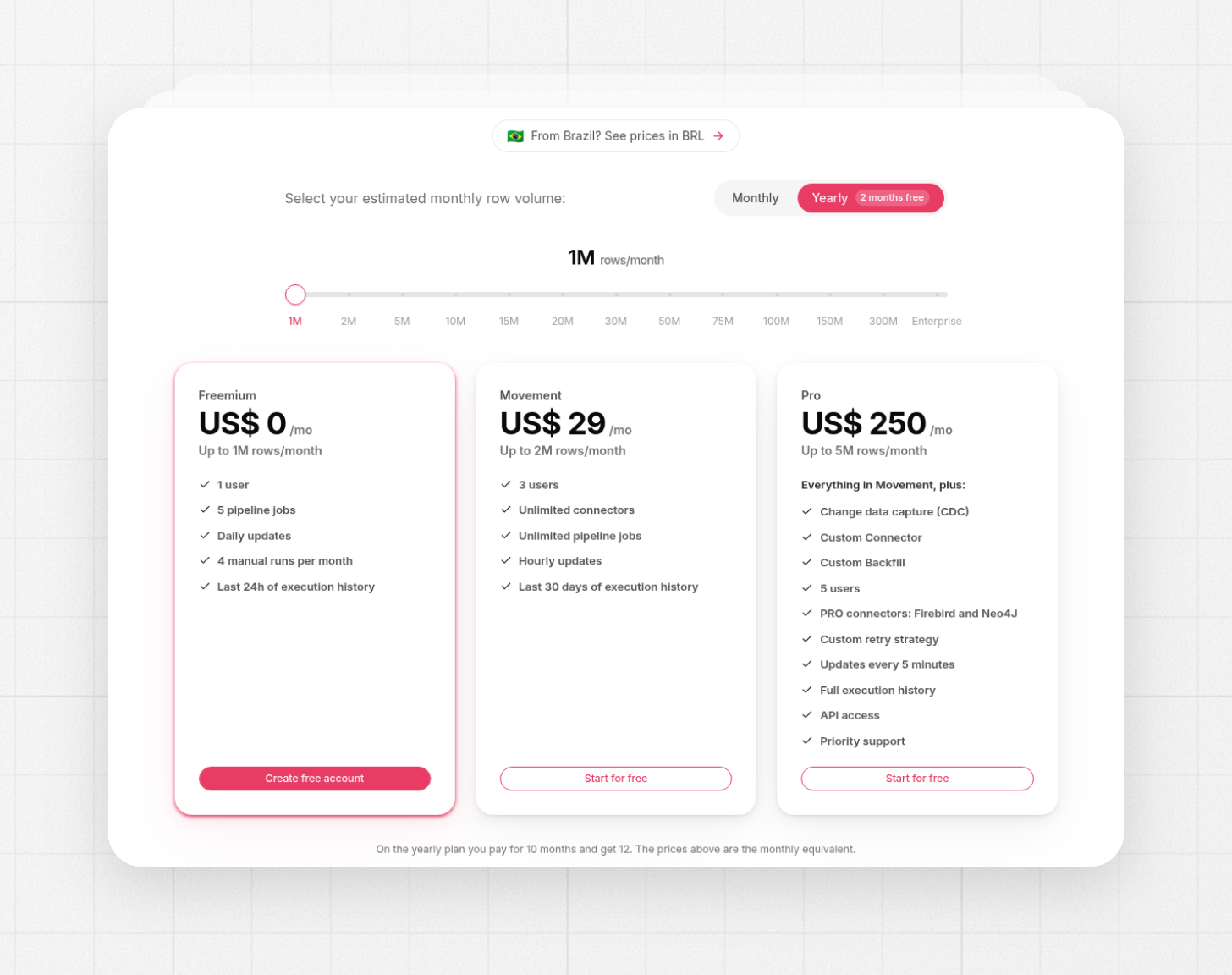
Erathos' monthly plans look like this:
FAQ
Is there free data integration software for small businesses?
Yes, several hosted tools have free plans that are enough for your first few sources:
- Erathos: up to 1M rows a month, 1 user, daily updates.
- Fivetran: up to 500,000 MAR, and the $5 connection minimum only applies to paid plans.
- Hevo: up to 1M events a month.
- Estuary: up to 2 connectors and 10 GB a month.
- Nekt: 40 credits and a 10 GB warehouse.
Airbyte's open source version is also free, but you run the servers yourself.
Should a small business self-host Airbyte to save money?
Only if someone on your team knows how to run servers. Even trying the open source version on a laptop needs 4 or more CPUs and 8 GB of memory, and production installs run on Kubernetes, with upgrades you do yourself. And when a sync breaks, you're the one fixing it.
Do these tools clean and transform the data?
Most of them load raw tables and leave the cleanup to SQL in your warehouse. Erathos handles extraction and loading, and you transform with SQL or dbt in the warehouse. Weld and Nekt include SQL editors in the product, and Nekt adds Python notebooks.
How hard is it to switch tools later?
Switching is easiest when the data lands in a warehouse you own. You connect the new tool to the same sources, reload history, and point your dashboards at the new tables. With a bundled warehouse it's harder, since you have to move the storage too. Nekt's Growth plan can run inside your own AWS or GCP account, so the storage stays with you.