Best Fivetran Alternatives for Startups
Compare the 9 best Fivetran alternatives for startups in 2026: pricing, CDC support, and connectors for Erathos, Airbyte, Estuary & more.
The best Fivetran alternatives for startups in 2026 are Erathos, Airbyte, Estuary, Hevo, Weld, Matillion, dlt, Kondado, and Nekt. The right pick depends on three things: what the billing meter counts, whether you want a managed platform or your own infrastructure, and whether you need change data capture (CDC), which reads the database log to sync inserts, updates, and deletes as they happen.
The prices in this article come from the vendors' official pages, checked in August 2026. Pricing pages change, so click through before you sign anything.
Why are startups looking for Fivetran alternatives in 2026?
Fivetran changed its pricing twice in two years, and both changes cost more for accounts with many small connections. In March 2025, volume tiering moved from the account level to the connection level. Since January 2026, deletes and history-mode updates count toward paid usage, and a minimum charge applies per connection.
Fivetran bills on monthly active rows (MAR): the unique primary keys it moves from a source to your destination each month. Volume discounts used to pool across the whole account. Now each connection earns its discount alone, and Fivetran's own FAQ says users with many equal-sized connections will see increased prices. On top of that, Standard connections that generate between 1 and 1 million MAR now carry a $5 base charge each.
Fivetran's pricing has upsides too. The free plan includes 500,000 MAR per month, each new connection gets 14 days of free use, and since March 2025 resyncs of identical rows are free.
Fivetran's own pricing page shows what a small stack costs at Standard list price: four marketing connectors (Facebook Ads, Google Analytics 4, Marketo, Google Ads) add up to $549.36 per month for a company with 1 to 200 employees. That estimate is the number behind this comparison.
What should a startup compare besides the entry price?
Compare five things: the billing meter, the quota included at the entry price, connector fit for your exact sources, who operates the pipelines, and which plan includes CDC. Two tools can bill the same workload very differently because they count different things.
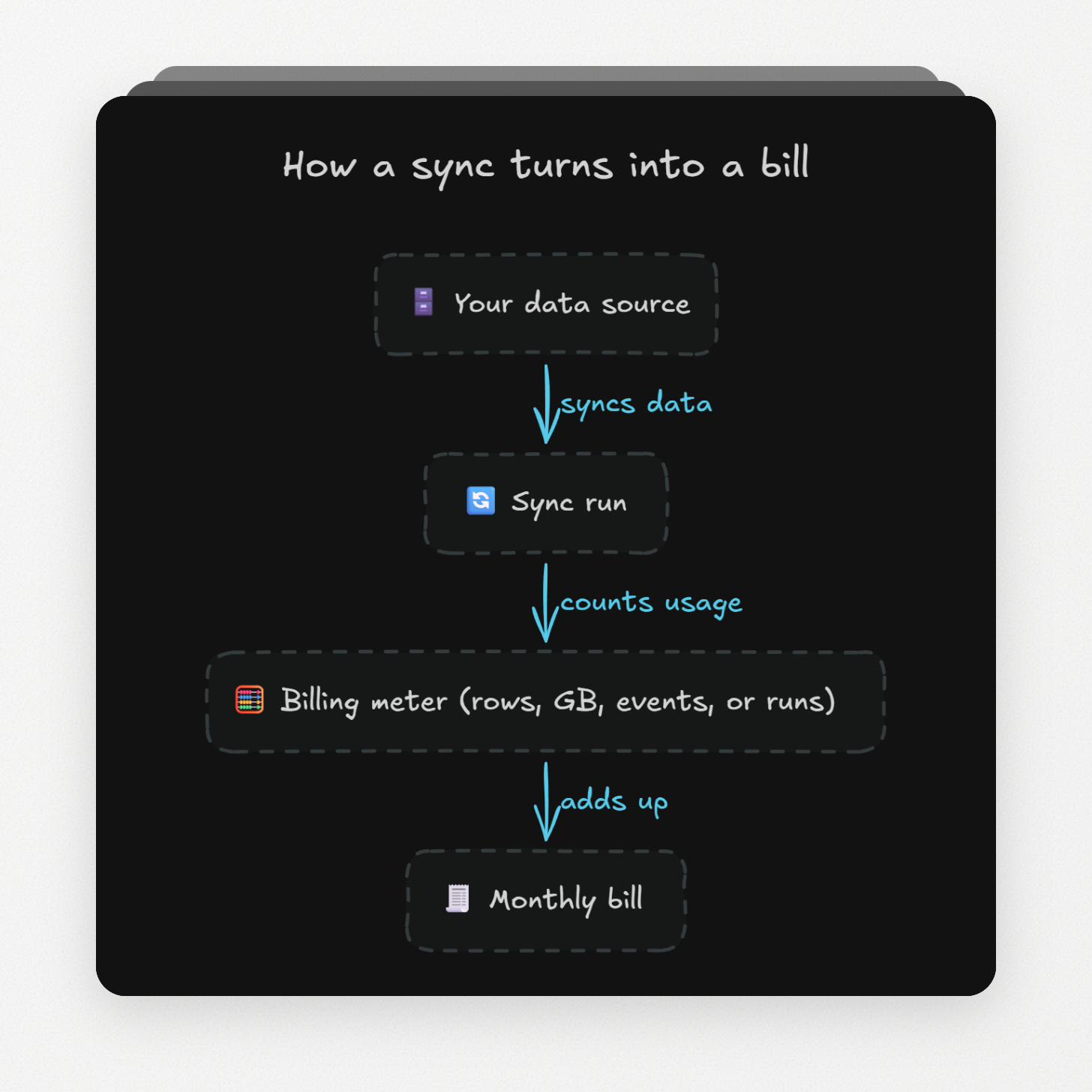
The meters across this list: rows written to the warehouse (Erathos), credits spent per million rows or per GB (Airbyte), GB plus connector instances (Estuary), events (Hevo), MAR plus connector count (Weld), task-hour credits (Matillion), and pipeline runs (Nekt).
The meter decides which of your habits get expensive. On a per-run meter, syncing every five minutes costs more than syncing daily. On a row meter, a source with wide, frequently updated tables costs more than a quiet one. Before you shortlist anything, look at your own sources and estimate what each meter would count.
What are the best Fivetran alternatives for startups in 2026?
Nine tools cover the realistic startup shortlist. The table below normalizes each one to its billing meter, public entry price, and where CDC starts, all from official pages.
Tool | What you pay for | Entry paid price | Connectors | Free tier or trial | CDC |
|---|---|---|---|---|---|
Rows written to the warehouse | $29/mo, up to 2M rows | 139 | Free up to 1M rows/mo; 14-day Pro trial | Pro and Enterprise | |
Credits: rows for APIs, GB for databases | $10/mo with 4 credits | 600+ | 30 days or 400 credits | Listed; plan scope not stated | |
GB plus connector instances | $0.50/GB + $100 per connector | 200+ | Free up to 10 GB/mo; 30-day Cloud trial | Yes, for supported databases | |
Events written to the destination | $265/mo (annual) | 150+ | Free up to 1M events/mo; 14-day trial | Streaming on Professional and up | |
Fixed tier with MAR and connector allowance | $99/mo (annual), 5M MAR, 2 connectors | Not stated | 14-day trial | Business add-on (+$479/mo) or Enterprise | |
Credits from task hours and users | Not published | Not stated | Free trial offered | Scale plan only | |
Free open source; you run it | $0 (Apache 2.0) | Not stated | Always free | In paid dltHub plans | |
Monthly plans | From R$99/mo | 80+ | 14 days, 10M records, no card | Not stated | |
Credits, one per pipeline run | $149/mo, 1,000 credits | 100 (includes destinations and visualizations) | Free plan, 40 credits/mo | Growth and Custom |
Erathos
Erathos is a managed data ingestion platform priced on rows written to your warehouse. The free plan covers up to 1 million rows per month with daily updates. Movement is $29 per month for up to 2 million rows, 3 users, hourly updates, and no limit on connectors or jobs. Pro is $250 per month for up to 5 million rows and adds CDC, custom connectors, updates every 5 minutes, and API access. The annual plan bills 10 months for 12.
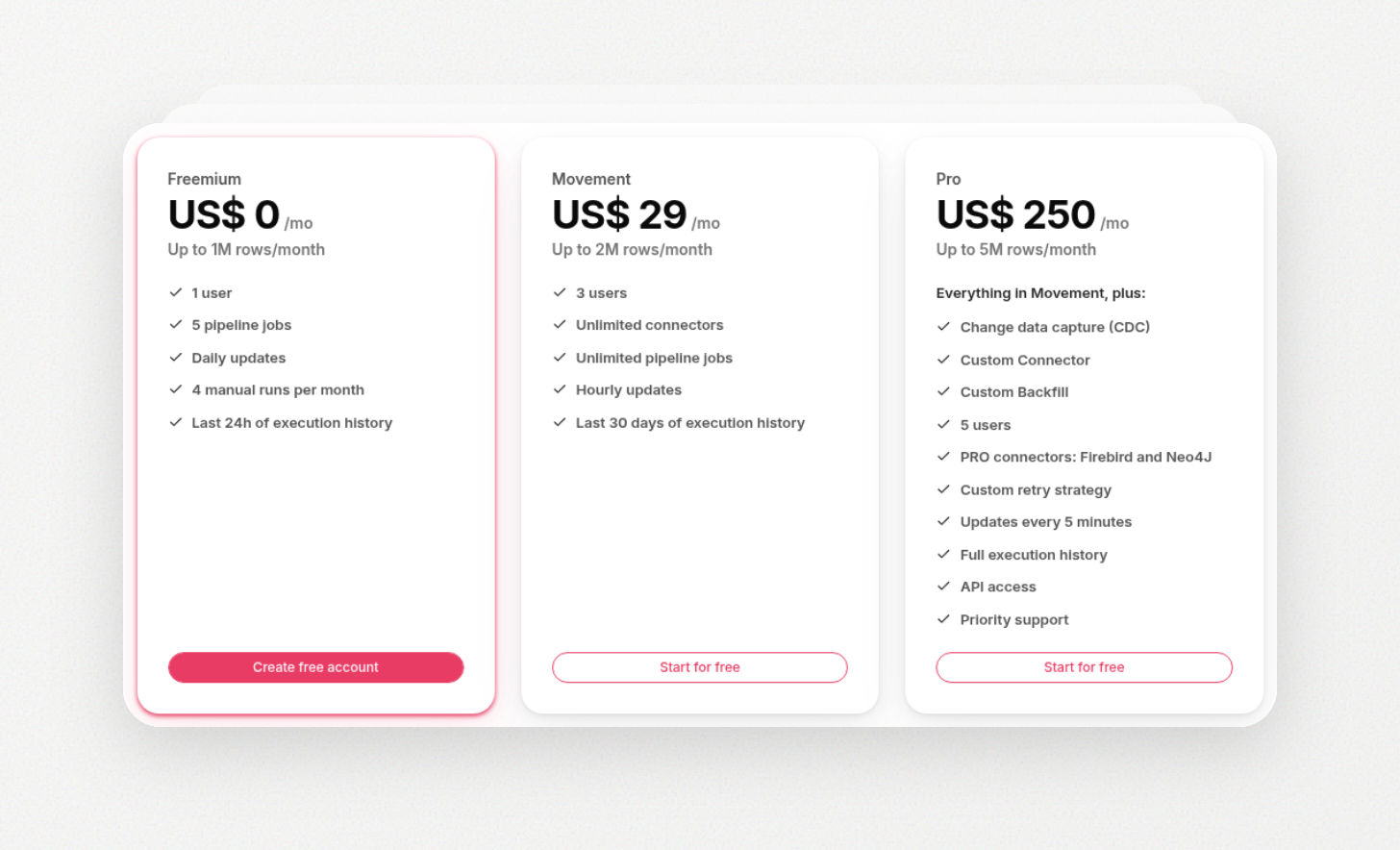
Erathos plans on the official pricing page, August 2026
The connector catalog lists 139 connectors, including Brazilian systems like Conta Azul, Mercado Livre, Omie, and RD Station, with BigQuery, ClickHouse, Databricks, Redshift, Postgres, SQL Server, and Supabase as destinations. Each pipeline can run as batch, cursor-based incremental, or CDC. Observability includes full run history, error context per run, and failure alerts in Slack, Discord, or email. The honest limit for a startup budget is that CDC starts on Pro, at $250 per month.
Airbyte Cloud
Airbyte Cloud starts at $10 per month with 4 credits included, and extra credits cost $2.50 each. API and custom sources bill $15 per million rows. Databases and files bill $10 per GB, measured in Airbyte's own serialized format. That format can be larger than the same data measured in the database. It offers 600+ connectors.
Two billing details matter. Full refresh syncs charge every row, every time. And when credits run out, scheduled syncs keep running and Airbyte bills the extra usage in arrears, so the $10 entry price says little about the monthly total.
Estuary
Estuary syncs with CDC for supported databases and offers millisecond latency or batch at no extra charge. The Developer tier is free up to 10 GB per month with 2 concurrent connector instances. Cloud costs $0.50 per GB plus $100 per month for each of the first 6 connector instances, then $50 for each one after that, across 200+ connectors. The per-connector fee means a stack with many small sources carries a fixed cost floor before any data moves.
Hevo
Hevo bills per event: each record inserted, updated, or deleted in the destination counts as one. The free plan covers up to 1 million events per month with 5 users. Starter costs $265 per month on annual billing ($299 monthly) with 150+ connectors and 10 users. Usage above the plan quota bills as On-Demand on top of the plan, and streaming pipelines start on Professional at $750 per month annual.
Weld
Weld sells fixed tiers. Basic starts at $99 per month billed annually with 5 million MAR included, 2 connectors, 1 user, and daily syncs; each extra 5 million MAR costs $49 per month. Premium ($389) moves to 1-hour syncs and 6 connectors, Business ($959) to 15-minute syncs and 50 million MAR. CDC costs an extra $479 per month on Business or comes with Enterprise. The fixed allowance makes the bill easy to predict, and the connector count limit is the number to check first.
Matillion
Matillion bills consumption credits, spent on task hours and extra developer users. The Developer plan includes one developer user, pre-built connectors, a low-code canvas with SQL and Python, and a built-in Git repository. The pricing page publishes the meter but no numeric credit price, and streaming CDC appears only on the Scale plan. For a startup that wants a number before a sales call, the other eight tools publish one.
dlt
dlt is an open-source Python library under Apache 2.0, free at any volume. Your team writes the pipelines in code and owns the infrastructure, scheduling, and monitoring. dltHub, the managed runtime from the same company, starts at $1,190 per month with 500 credits, where one credit covers one hour of runtime, and paid plans include CDC. Every dltHub subscription starts with a 14-day trial and $30 in credits.
Kondado
Kondado is a Brazilian no-code platform, managed in Kondado's cloud, with plans starting at R$99 per month. It lists more than 80 connectors and free loading of historical data. The trial runs 14 days with up to 10 million records and 30 integrations, no credit card. Its public pages don't state CDC support, so ask before you shortlist it for log-based replication.
Nekt
Nekt charges credits per pipeline run: each execution of a source, transformation, or destination spends one credit, and failed runs are free. The free plan includes 40 credits per month; Starter is $149 per month with 1,000 credits. Log-based CDC starts on Growth at $499 per month. Its stated count of 100 connectors includes sources, destinations, and visualizations, so compare it with care against source-only counts.
Is Airbyte cheaper than Fivetran for startups?
Airbyte Cloud has the lower entry price: $10 per month with 4 credits, against Fivetran's per-connection MAR pricing with a $5 base charge per small Standard connection. Whether it stays cheaper depends on your sources and how they sync.
Three details decide it. Fivetran's free plan covers 500,000 MAR per month, so a very small stack can run on Fivetran for $0 while Airbyte bills from the first credit after trial. Airbyte charges every row on full refresh syncs, while Fivetran marks identical-row resyncs free. And Airbyte keeps syncing past your prepaid credits and bills the difference, so a misconfigured hourly full refresh shows up on the invoice, and only there.
Run both against your real sources for two weeks and multiply the metered usage into a monthly bill.
Which Fivetran alternative is best for a no-code startup?
For a startup with no data engineer, the managed no-code options are Erathos, Hevo, and Kondado. Erathos is free up to 1 million rows per month, Hevo is free up to 1 million events per month, and Kondado starts at R$99 per month after its trial.
The free tiers differ in the details. Erathos Freemium includes 1 user, 5 pipeline jobs, and daily updates; the $29 Movement plan lifts that to 3 users, hourly updates, and no limit on jobs. Hevo's free plan allows up to 5 users with 1-hour scheduling. For a team without a data hire, the setup and upkeep matter as much as the price; we wrote about centralizing data without a dedicated data team for exactly this case.
Which Fivetran alternative is best for real-time CDC?
Estuary, if CDC is the whole reason you're switching: it syncs supported databases through CDC by default, with millisecond latency or batch at no extra charge. On the other tools, CDC is a plan feature: Erathos Pro at $250 per month, Nekt Growth at $499 per month, Matillion Scale, and Weld Business as a $479 per month add-on.
CDC also has prerequisites on the source database side, and getting them wrong shows up as missing rows later. Our walkthrough of MySQL CDC to BigQuery covers what the source needs before the first sync, and the MySQL connector docs list the exact settings.
Is open source the right Fivetran alternative for a small startup?
Open source fits when someone on the team wants to own pipelines as code. dlt is free under Apache 2.0 at any data volume, and the cost moves from a vendor invoice to engineering time: writing the Python pipelines, running the infrastructure, and watching the monitoring.
The managed versions of the same idea put a price on that time. dltHub runs dlt pipelines for $1,190 per month with 500 runtime credits. Airbyte lists Core as its self-managed option next to the $10 Cloud entry. We'd rather build dashboards than babysit schedulers, so for a one-person data team, a managed row-priced plan often beats free software plus an on-call rotation of one.
How should a startup test a Fivetran alternative before migrating?
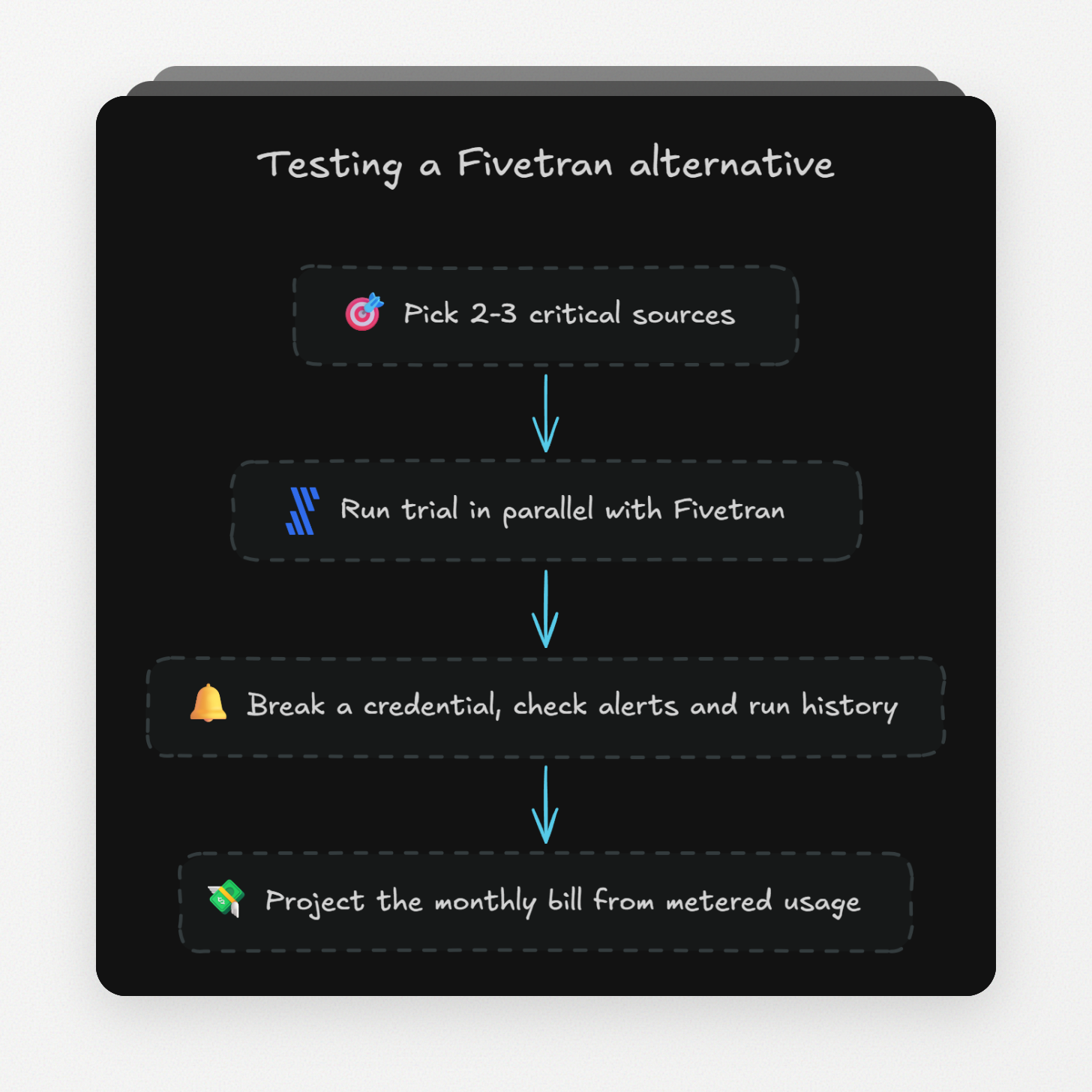
Run a trial against your two or three most important sources with real data, in parallel with Fivetran, and compare four things: data completeness in the destination, how fast you can debug a failed sync, CDC prerequisites on your sources, and the monthly bill projected from the trial's metered usage.
The trials are long enough for a real test: Fivetran gives 14 days free per new connection, Airbyte gives 30 days or 400 credits, Estuary gives a 30-day Cloud trial, and Erathos gives 14 days of Pro on signup, with Weld, Hevo, and Kondado at 14 days each.
The debugging test is easy to skip in a trial, and the first failed sync in production is a bad time to run it. Break a credential on purpose and watch what happens: whether the alert reaches you, and whether the run history and error context tell you why without a support ticket. Then check the controls you'll need later: retry policies, backfills, and scheduling per table.
For the bill, take what the trial metered on your real change rate and multiply it to a month. That number is the real comparison. The entry price only tells part of it.
The short version
- Managed, row-priced, free to start: Erathos
- Lowest entry price with usage billing: Airbyte Cloud
- Real-time CDC by default: Estuary
- Event-priced with a free 1M-event tier: Hevo
- Fixed, predictable tiers: Weld
- Free and open source, you run it: dlt
- Brazil-focused no-code: Kondado
- Per-pipeline-run pricing: Nekt
Ready to test one instead of reading about nine?
Erathos is free up to 1 million rows a month, connects to 139 sources — including Brazilian systems like Conta Azul, Mercado Livre, and Omie — and needs no credit card to start. If your stack needs CDC, custom connectors, or 5-minute updates, you can try Pro free for 14 days.