Best Fivetran Alternatives for High Data Volumes
Erathos, Airbyte, Hevo, Matillion, dlt & Estuary compared for high-volume data: what each bills on, published limits, and CDC pricing.
The best Fivetran alternatives for high data volumes are Erathos, Airbyte, Hevo, Matillion, dlt, and Estuary Flow. They differ most in what you pay for: rows, compute, events, credits, or gigabytes. That billing unit, more than any feature list, decides what a 100M-row month costs you.
Every price and limit below comes from the vendors' own pricing pages and docs, linked inline. Where a vendor publishes no number, this article says so instead of guessing.
Why do high-volume teams look for a Fivetran alternative?
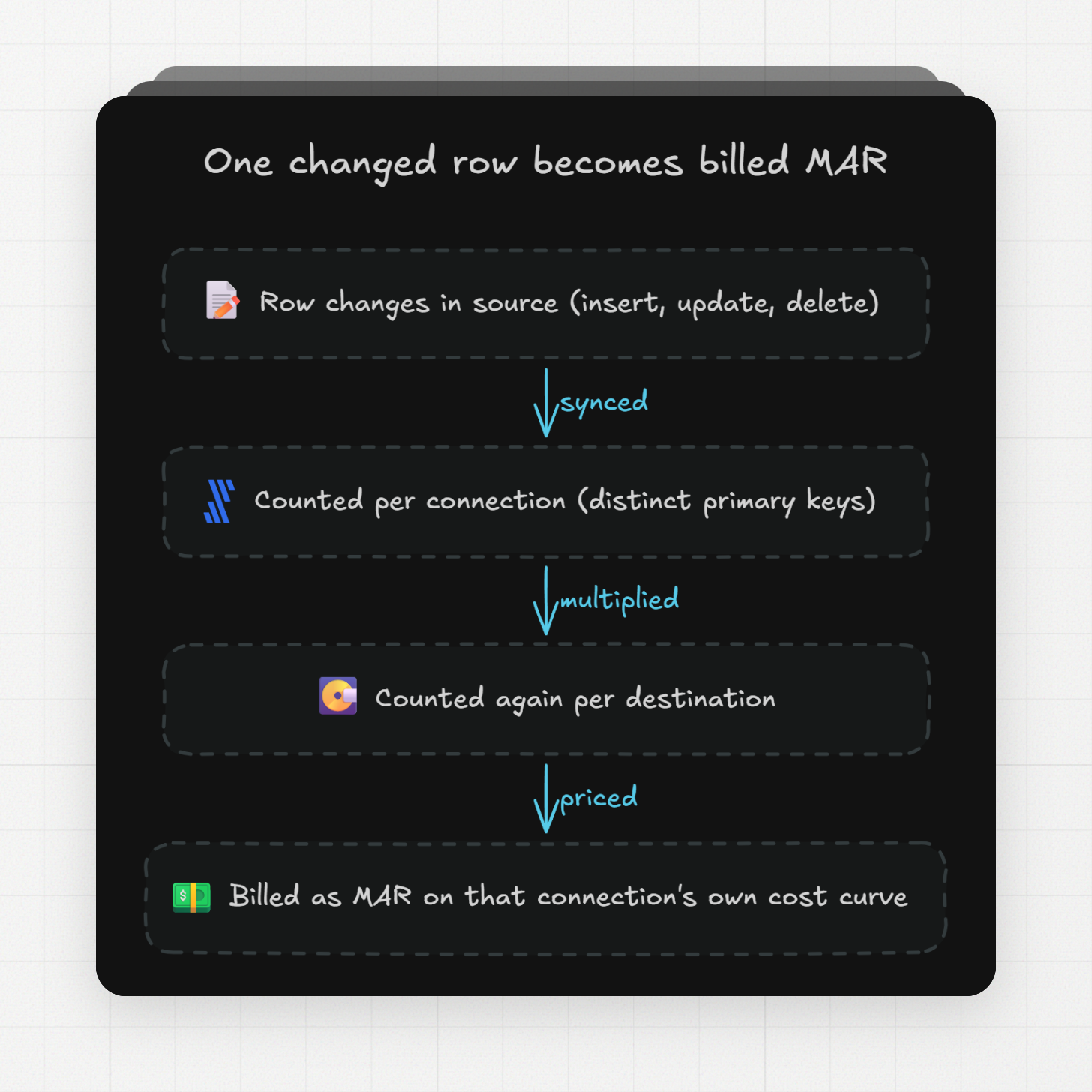
Fivetran bills monthly active rows (MAR): the number of distinct rows it syncs in a calendar month, counted by primary key. It counts inserts, updates, and deletes, and it counts them separately per connection, table, and destination. When your data changes a lot, the bill grows with it.
The per-connection counting is what costs the most at scale. Syncing the same source to two destinations counts the rows twice. And there is no public rate to plan around: the pricing page says each connection follows its own cost curve based on usage, so the price of your next million rows depends on which connection they arrive through. The free tier covers 500,000 MAR.
How did Fivetran's pricing change in 2025 and 2026?
Fivetran moved its volume discounts from the account level to the connection level on March 1, 2025, then added new paid categories on January 1, 2026: a $5 minimum per small standard connection, paid deletes, and paid repeated updates in History mode.
The 2025 change matters most if your volume is spread out. Fivetran's own FAQ says teams with many equal-sized connections see higher prices, while teams with one dominant connection see lower ones. Volume that used to pool into one account-wide discount tier now tiers per connection.
The 2026 changes cost the most when your data churns. Under the old rules a row counted once per month no matter how many times it changed. As of January 1, 2026, deletes count toward paid MAR, and History mode, which tracks every version of a row, bills each repeated update in the month.
How do Fivetran alternatives price high-volume data movement?
Six alternatives use five different billing units, and none of them convert to MAR. The only honest comparison is to price your own workload, with your own change rate and row width, against each model.
Tool | What you pay for | Entry point | Published high-volume detail |
|---|---|---|---|
MAR, per connection | Free tier: 500,000 MAR | No public per-MAR rate; each connection has its own cost curve | |
Rows written to the warehouse | Free up to 1M rows/month | Public plans through 300M rows/month; Enterprise up to 1.5 billion rows | |
Data Workers (compute) on Pro; volume on Standard | No public dollar price | Pro has no data-volume charges; a Data Worker runs about 3 syncs at once | |
Events (each insert, update, or delete in the destination) | Free up to 1M events/month; Starter from $265/month | Plan quotas run up to 100M events; above that is custom | |
GB moved plus connector instances | Free up to 10 GB/month | $0.50 per GB; first 6 connectors $100/month each, then $50 each | |
Credits, burned per rows loaded | No public credit dollar price | 100M to 500M rows/month band: one credit per 360,000 batch rows or 180,000 CDC rows | |
dlt is free open source; dltHub bills runtime credits | dlt: free, Apache 2.0; dltHub from $1,190/month | One credit covers one hour of runtime; 500 credits included per month |
The table can't show a dollar figure for the same 100M-row workload on every tool. Fivetran publishes no MAR rate, Airbyte publishes no Data Worker price, and Matillion publishes no credit price. Any article that prints a side-by-side dollar comparison at that scale made the numbers up.
Which Fivetran alternatives work best for high-volume warehouse ELT?
For scheduled warehouse loading at high volume, five tools stand out: Erathos, Airbyte, Hevo, Matillion, and dlt. Each section below covers when it fits.
Erathos
Erathos bills one thing: rows written to your data warehouse each month. The plans are public from free (1M rows) through $29/month (2M rows), $250/month (5M rows), and on up to 300M rows, with Enterprise custom plans up to 1.5 billion rows. Change data capture (CDC), which reads changes from the database's log instead of re-querying tables, is included on Pro and Enterprise, with 5-minute updates on Pro.
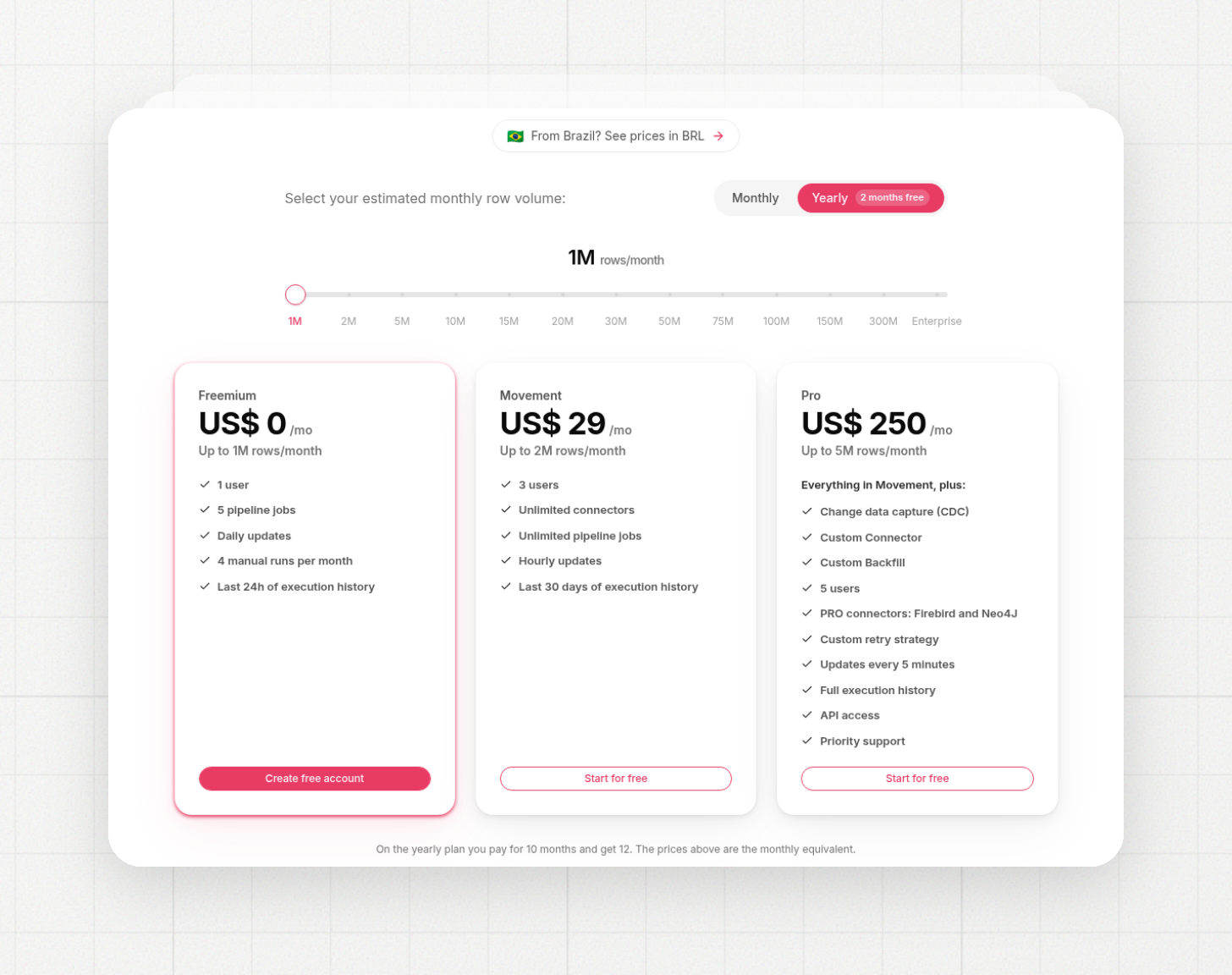
Erathos pricing plans, billed on rows written per month
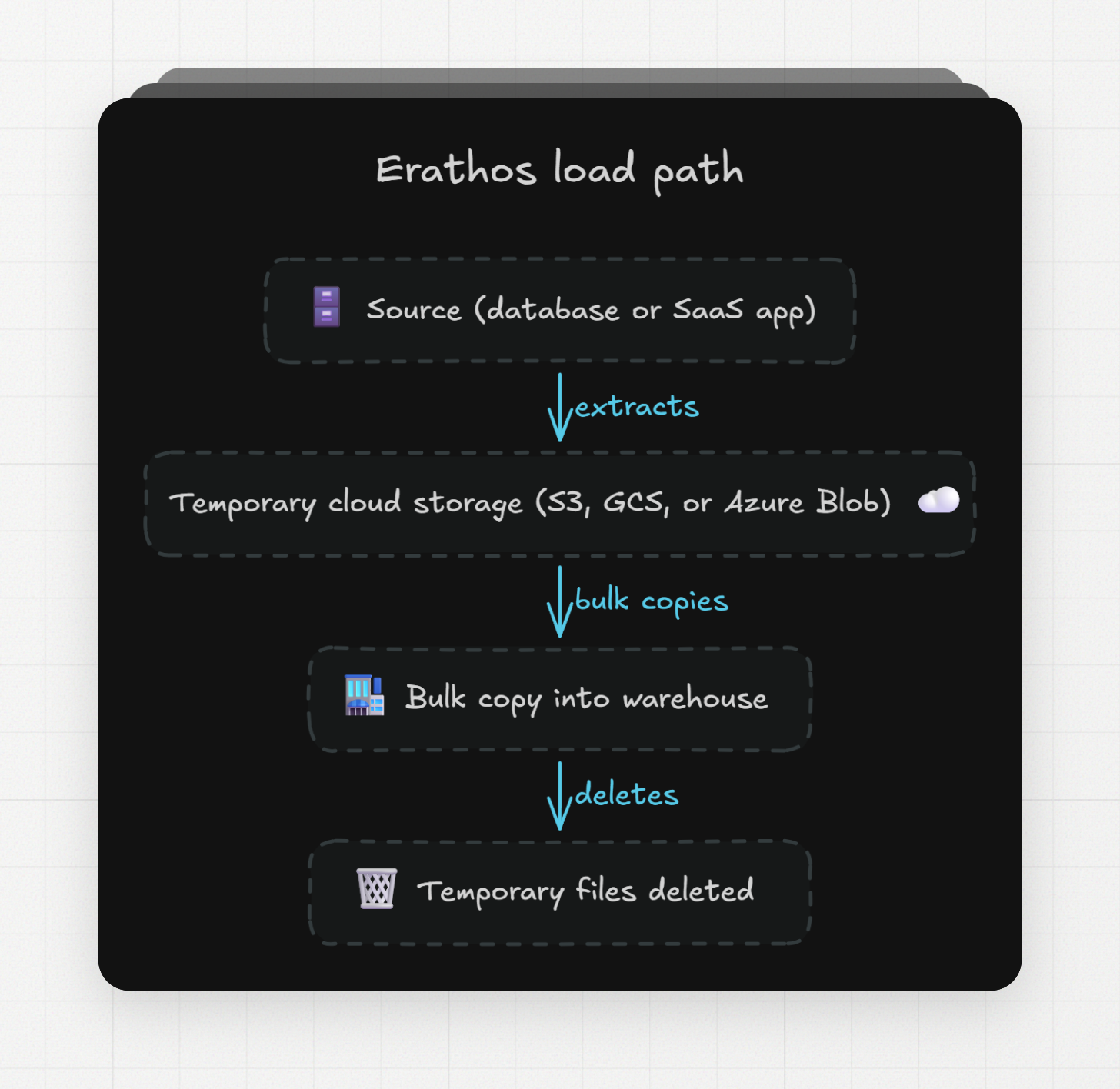
There are +100 connectors, and each pipeline can load by batch, cursor-based incremental sync, or CDC. During a load, Erathos stages extracted data in temporary cloud storage (S3, GCS, or Azure Blob) and bulk-copies it into the warehouse, then deletes the temporary files. Erathos says its customers process billions of rows every month.
Airbyte
Airbyte's Pro plan bills Data Workers, a unit of compute capacity, and Airbyte says the plan has no charges based on data volume. Each Data Worker runs about 3 syncs at once. There is no public dollar price, so budgeting starts with a sales quote. The Standard plan bills on volume instead, and its fastest sync frequency is 1 hour, against 15 minutes on Pro.
The self-hosted option is the open-source Airbyte Core, which syncs as often as every 5 minutes. Airbyte no longer sells Self-Managed Enterprise; it points new deployments to Cloud plans or Core.
Hevo
Hevo bills events: every record inserted, updated, or deleted in the destination counts as one. Starter begins at $265/month on annual plans, and plan quotas run up to 100M events on Professional, with Business Critical custom above that. Usage past your quota bills as On-Demand on top of the plan.
Two settings drive high-volume cost and freshness. More frequent ingestion consumes more events, and the defaults are 30 minutes for log-based pipelines and 6 hours for table-mode pipelines. And when the destination loads slower than Hevo ingests, data piles up in staging, so freshness depends on the warehouse side too.
Matillion
Matillion bills credits, and its Data Loader burns them per rows loaded, with CDC rows costing double in the mid bands: in the 100M-to-500M rows/month band, one credit covers 360,000 batch rows but only 180,000 CDC rows. In the 500M-to-10B band, batch and CDC both get 2M rows per credit. The dollar price of a credit is quote-based.
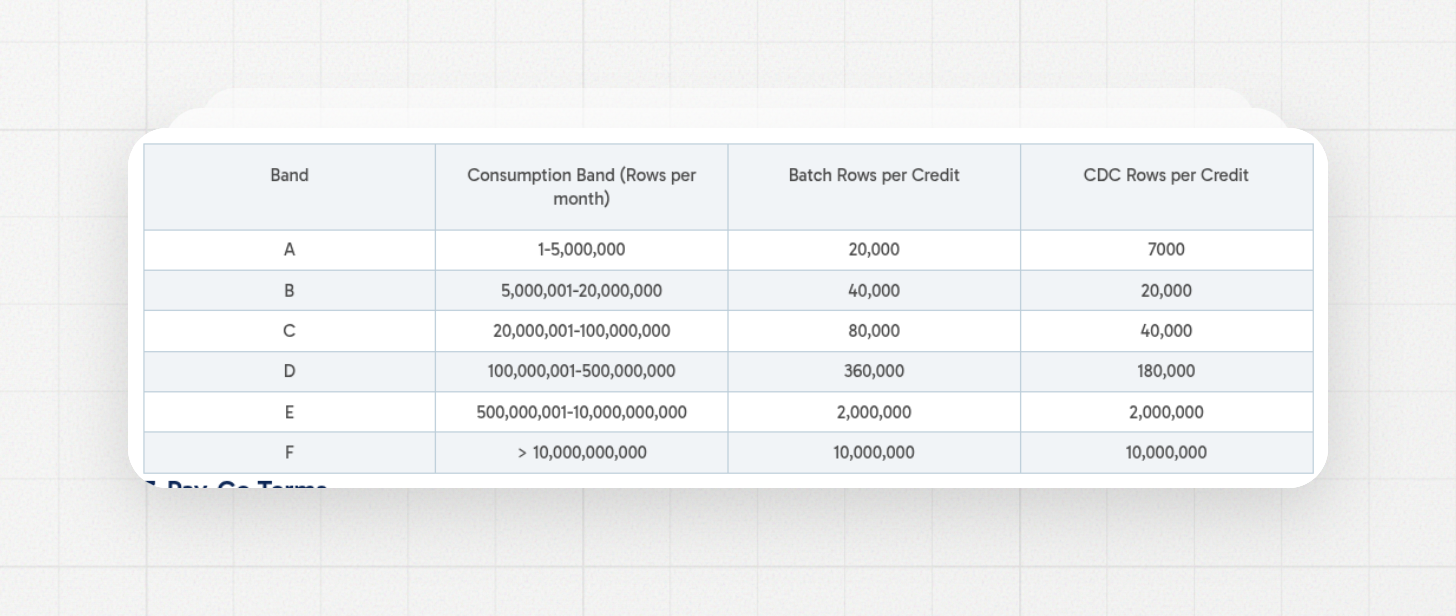
Matillion Data Loader credit consumption bands, from its credit consumption terms
Streaming CDC comes with the Scale edition, alongside hybrid deployment and SSO. Matillion makes most sense when the transformation platform is the reason you're there and loading rides on the same credits.
dlt
dlt is a free, Apache 2.0 licensed Python library with incremental loading, schema evolution, and deployment anywhere Python runs. The cost model is your own infrastructure and your own engineers' time. dltHub's pricing page is direct that the open-source path is for teams that want full infrastructure ownership, and it labels the verified open-source connector set limited.
The managed option, dltHub, starts at $1,190/month with 500 runtime credits, where one credit is one hour of runtime. CDC there is a paid, source-available capability.
Two regional options are Kondado, a no-code platform with plans from R$99/month, and Nekt, which claims 200+ connectors. Neither publishes high-volume pricing or CDC throughput, so treat them as regional options to trial rather than proven high-volume replacements.
When is Estuary Flow the better high-throughput CDC alternative?
Estuary Flow fits when you need streaming CDC with latency in seconds and your workload is compact in bytes, because Estuary bills $0.50 per GB moved plus connector instance fees, so cost tracks data size instead of row count.
The pricing is public: free up to 10 GB/month, then $0.50 per GB, with the first 6 connector instances at $100/month each and $50 for each one after. Estuary says it syncs in real time by default and claims under 100 milliseconds end-to-end delivery. One of its guides claims throughput up to 7+ GB/s. Those are Estuary's own numbers, so test them on your workload.
The GB unit cuts both ways. Millions of small changed rows can be cheap because they weigh little. Wide rows, JSON blobs, or re-synced tables cost more, since every byte through the pipeline bills, and per-connector fees add up in a stack with many sources.
Is Airbyte cheaper than Fivetran at high data volume?
Neither vendor publishes the number that would settle it: Fivetran shows no per-MAR rate and Airbyte shows no Data Worker price, so the answer needs a quote from each for the same workload. The models do point in different directions, though.
Airbyte Pro charges for compute capacity, so a workload with a huge change rate flowing through a few connections keeps a flat compute bill while the same churn drives Fivetran's MAR up every month. The reverse holds for many small, mostly static connections: Fivetran's 2026 rules put a $5 floor under each standard connection, and Airbyte still needs enough Data Workers to run them all. Price both against your real connection list before deciding.
Which high-volume CDC caveats should you test before migrating?
The caveats to test are the source database's log settings and failure behavior: binlog format and retention on MySQL, and replication slots plus log retention on PostgreSQL. These settings decide whether a high-volume CDC pipeline survives a stall or an outage.
For MySQL, CDC reads the binary log (binlog), and binary logging must run in ROW format with FULL row images. MySQL keeps binlogs 30 days by default, and a paused pipeline that outlives retention has to re-snapshot. The snapshot mode matters too, since an initial-snapshot sync of a large table is a different load than streaming changes only.
For PostgreSQL, CDC needs wal_level set to logical plus free replication slots. A replication slot retains unlimited write-ahead log (WAL) data by default, so a stalled consumer can fill the database's disk. Setting a ceiling with max_slot_wal_keep_size protects the source. A step-by-step MySQL CDC setup is a cheap way to run this whole checklist on a real table before committing.
The short version
- Published prices at high row counts, CDC included: Erathos, plans through 300M rows and Enterprise to 1.5B.
- Pay for compute instead of volume: Airbyte Pro, quote-based.
- Event billing with quotas to 100M: Hevo.
- Loading bundled with a transformation platform: Matillion credits.
- Full ownership in Python: dlt, free.
- Streaming CDC billed by the GB: Estuary Flow.
Whichever way you go, get each vendor to price the same workload: your connection count, change rate, row width, and freshness target. The billing units differ too much for anything else to be a real comparison.
See what your own workload actually costs on Erathos
Erathos is the only tool on this list with public pricing all the way from free to 300M rows a month, CDC included from Pro. No sales quote needed to get a real number for your workload. Try Erathos free for 14 days.