Best Cloud Data Warehouses in 2026: Snowflake, BigQuery & Redshift Compared
Compare Snowflake, BigQuery, and Redshift on pricing, architecture, and benchmarks. See which warehouse fits your stack and budget.
Snowflake, Google BigQuery, and Amazon Redshift store the same kind of analytical data and run the same kind of SQL. The biggest difference between them is the meter. Snowflake bills credits per warehouse-hour, BigQuery bills bytes scanned or slot-hours, and Redshift bills node-hours or RPU-hours (an RPU is Redshift's unit of serverless compute capacity). Picking a warehouse means picking a meter and an operating model you will live with for years.
The prices in this guide are official list prices with their region named, and the feature claims link to official docs.
What is the best cloud data warehouse in 2026?
The best cloud data warehouse depends on your cloud: BigQuery for teams on Google Cloud, Redshift for teams on AWS, and Snowflake for teams that run on more than one cloud or want strict compute isolation between workloads. No recent benchmark shows one engine winning for all workloads.
Your setup | Best fit | Why |
|---|---|---|
Data and tools on Google Cloud | BigQuery | Serverless, with no instances or VMs to provision |
Data on AWS, often with an S3 data lake | Redshift | AWS service with free data transfer to S3 in the same region for loads and unloads |
More than one cloud, or many isolated workloads | Snowflake | Runs on AWS, Azure, and Google Cloud, and teams can get separate warehouses |
These picks come from architecture and ecosystem fit. Performance depends on your queries.
How do Snowflake, BigQuery, and Redshift architectures differ?
They differ in who runs the compute: Snowflake gives you virtual warehouses you size and suspend yourself, BigQuery assigns compute slots to queries with no machines for you to manage, and Redshift gives you either provisioned clusters you size or Serverless capacity measured in RPUs.
Snowflake splits into three layers: storage, virtual warehouses for compute, and cloud services. A warehouse comes in sizes from XS to 4XL. An XS uses 1 credit per hour, and the rate doubles with size up to 128 credits per hour for a 4XL. Warehouses run side by side against the same storage, so a heavy dashboard load cannot slow down your data science team. Multi-cluster warehouses, which add clusters when queries queue up, need Enterprise edition or higher.
A BigQuery slot is a virtual compute unit. On-demand queries pull slots from a shared pool. Capacity reservations give you a set number of slots, and Google scales reservations almost instantly. Redshift Serverless measures compute in RPUs, where one RPU comes with 16 GB of memory and base capacity can go from 4 to 1024 RPUs.

How much do Snowflake, BigQuery, and Redshift cost in 2026?
Snowflake on-demand compute costs $2.00 to $4.00 per credit by edition on AWS US East (N. Virginia). BigQuery charges $6.25 per TiB scanned on-demand, or $0.04 to $0.10 per slot-hour in Iowa (a TiB is a bit more than a terabyte). Redshift Serverless costs $0.375 per RPU-hour in US East (N. Virginia).
The regions differ because that is how the three vendors publish list prices. Check your own region before budgeting.
Warehouse (region) | Compute list price | Storage list price | Billing minimum |
|---|---|---|---|
Snowflake (AWS US East, N. Virginia) | $2.00 Standard, $3.00 Enterprise, $4.00 Business Critical per credit | Per second after a one-minute minimum on resume | |
BigQuery (Iowa, us-central1) | $6.25 per TiB scanned on-demand, or $0.04 to $0.10 per slot-hour by edition | $23.552 per TiB per month for active logical storage | On-demand per query; capacity per second with a one-minute minimum by default |
Redshift (US East, N. Virginia) | Serverless $0.375 per RPU-hour; provisioned from $0.543 per hour | $0.024 per GB per month managed storage | Serverless per second with a 60-second minimum |
Storage is close to a tie. All three land between $23 and $24 per terabyte-month at list price, so compute is where the bills diverge.
A worked example for Snowflake: a Medium warehouse uses 4 credits per hour, so on Standard edition it costs 4 x $2.00 = $8.00 per hour while it runs, whether queries come in or the warehouse waits.
The free allowances differ too. BigQuery gives you the first 1 TiB of queries and the first 10 GiB of storage free each month. New Redshift Serverless users get a $300 credit that expires after 90 days. BigQuery capacity commitments come with a 20% discount for one year and 40% for three years.
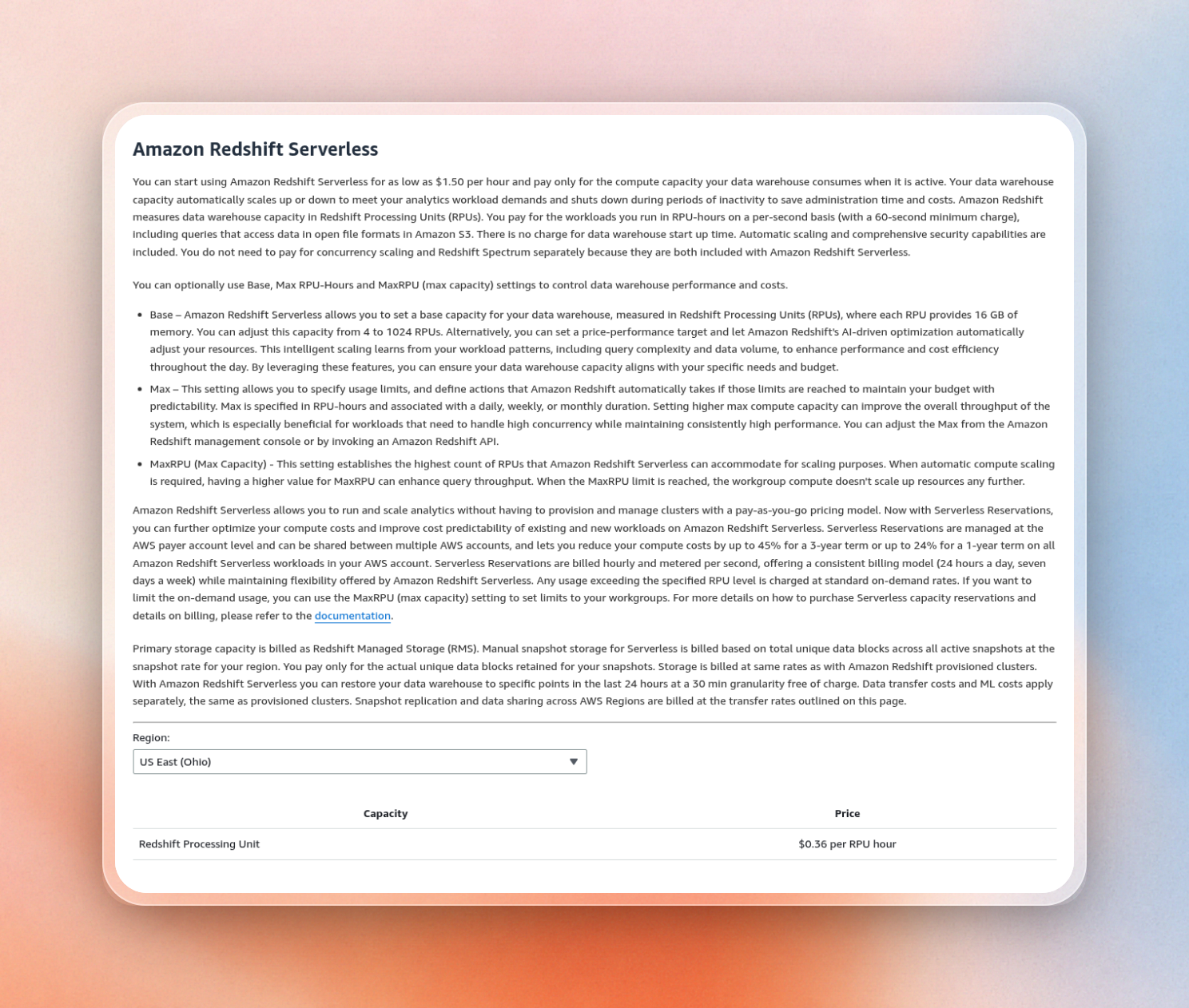
Redshift Serverless pricing on the AWS pricing page. The default region shown is US East (Ohio), where an RPU-hour is $0.36; N. Virginia is $0.375.
Which pricing model is easier to control in practice?
Redshift Serverless and BigQuery on-demand are the easiest to keep near zero when idle, because neither bills while no queries run. Snowflake bills any warehouse that is running, and BigQuery bills the capacity baseline at all times.
A Snowflake warehouse uses credits the whole time it runs, with or without queries. Auto-suspend fixes most of this, and a low timer like 5 or 10 minutes limits how long an idle warehouse keeps billing. A resume restarts the one-minute minimum charge, and a suspended warehouse loses its local cache, so a very short suspend timer trades money for speed.
BigQuery on-demand cost follows the bytes a query scans, so one query over a huge table can cost more than a full day of small ones. On the capacity side, the baseline is the slot count that is always allocated and always charged, and autoscaled slots bill per second with a one-minute minimum by default.
A provisioned Redshift cluster bills while it runs. Serverless bills RPU-hours per second with a 60-second minimum charge, and the base capacity setting limits how much it can spend.
Data movement is its own line item. Snowflake charges nothing to bring data in but does charge for egress, and copying data between regions or clouds adds transfer fees. Snowflake's cloud services layer is only charged when its daily use goes past 10% of daily warehouse usage.
How do Snowflake, BigQuery, and Redshift compare on performance?
The two most cited performance tests are vendor-run, and their setup choices decide a lot of what they find.
The newest is ClickHouse's CostBench, which ran 43 ClickBench queries at 1, 10, and 100 billion rows on Snowflake, BigQuery, Redshift, Databricks, and ClickHouse Cloud. The setup matters more than the topline numbers. It reports hot runtimes (best of three runs) with result caches turned off, and it prices compute as if all systems billed per second. It ran Snowflake on Gen 1 warehouses, BigQuery both with a 2,000-slot reservation and at on-demand prices, and Redshift Serverless at the default 128 RPUs. It says nothing about idle cost or cold starts.
The older Fivetran and Brooklyn Data benchmark ran 99 TPC-DS queries on 1 TB of data, one query at a time, back in 2022. TPC-DS is a standard set of analytics test queries. The test skipped sort keys, clustering, and date partitioning on purpose, so it measured untuned engines. Fivetran's own write-up says benchmarks from vendors that favor their own product "should be taken with a grain of salt."
A benchmark on your own queries beats both.
Where do Iceberg, data sharing, and machine learning support differ?
All three warehouses work with Apache Iceberg, an open table format that keeps data in your own cloud storage, and all three have a data sharing feature. The details differ enough to swing a decision.
Warehouse | Apache Iceberg | Data sharing |
|---|---|---|
Snowflake | Iceberg tables keep data and metadata in your own S3, Google Cloud Storage, or Azure storage with no Snowflake storage cost, though compute is still billed | Secure Data Sharing copies no data; shared objects are read-only and consumers pay only query compute |
BigQuery | Iceberg managed tables in your own Cloud Storage buckets with no BigQuery storage fee, but no JSON data type support | |
Redshift | Queries Iceberg tables cataloged in AWS Glue; RA3 nodes go through Spectrum, and Iceberg time travel is unsupported | Live sharing with no copy across clusters, workgroups, accounts, and regions |
For machine learning in SQL, BigQuery ML comes with Enterprise, Enterprise Plus, and on-demand. Redshift ML lets SQL users train models through SageMaker AI and then run predictions from the database.
Should a GCP, AWS, or multi-cloud team pick Snowflake, BigQuery, or Redshift?
The cloud that holds your data usually decides the pick: BigQuery runs on Google Cloud, Redshift runs on AWS, and Snowflake runs on AWS, Azure, and Google Cloud. Moving data across clouds adds transfer charges on top of compute and storage.
The other question is who you want doing the tuning. With BigQuery, Google runs the compute and your main job is watching scanned bytes and reservations. With Snowflake and Redshift, sizing decisions (warehouse sizes and suspend timers, or clusters and RPU limits) belong to your team, which gives you more control and more ways to overspend.
What should you test before choosing a data warehouse?
Run a short proof of concept (POC) with your production data and real query mix on configurations of similar list cost, and measure compute, storage, data movement, and idle time. Numbers from someone else's setup say little about yours.
- Load the same production tables into two or three candidates with the same ELT pipeline (extract, load, then transform the data), so the engines get identical data.
- Run your real query mix, including your peak concurrency, instead of one query at a time.
- Match configurations by list cost per hour.
- Keep the trial running through nights and weekends, so idle behavior shows up in the bill.
- Count storage, transfer, and ingestion along with compute.

Loading the same data into several candidate warehouses is the slowest part of a POC, and it is the part we built Erathos for: over 100 sources, with BigQuery and Redshift as destinations, and pipelines that run incrementally by default. You can test either destination free for 14 days. If BigQuery wins your POC, our guide on moving MySQL data to BigQuery with CDC (change data capture, copying only the rows that changed) is a good next step.
Ready to stop guessing and start testing?
Loading the same production data into two or three warehouses is the slowest part of any Snowflake vs BigQuery vs Redshift POC. Erathos handles that step for you: pipelines from over 100 sources, running incrementally by default, straight into BigQuery, Redshift, and more.
Start your free 14-day trial with Erathos and load your real data into your top candidates before you commit.