Rivery (Boomi Data Integration): Preço e Alternativas
O que é o Rivery (agora Boomi Data Integration), como funciona o preço por crédito BDU, e as melhores alternativas para comparar em 2026.

Rivery is a SaaS ELT platform, and since December 2024 it has been a Boomi product called Boomi Data Integration. This guide covers what the product is today, how its credit pricing works, and which alternatives to compare it against.
What is Rivery in 2026?
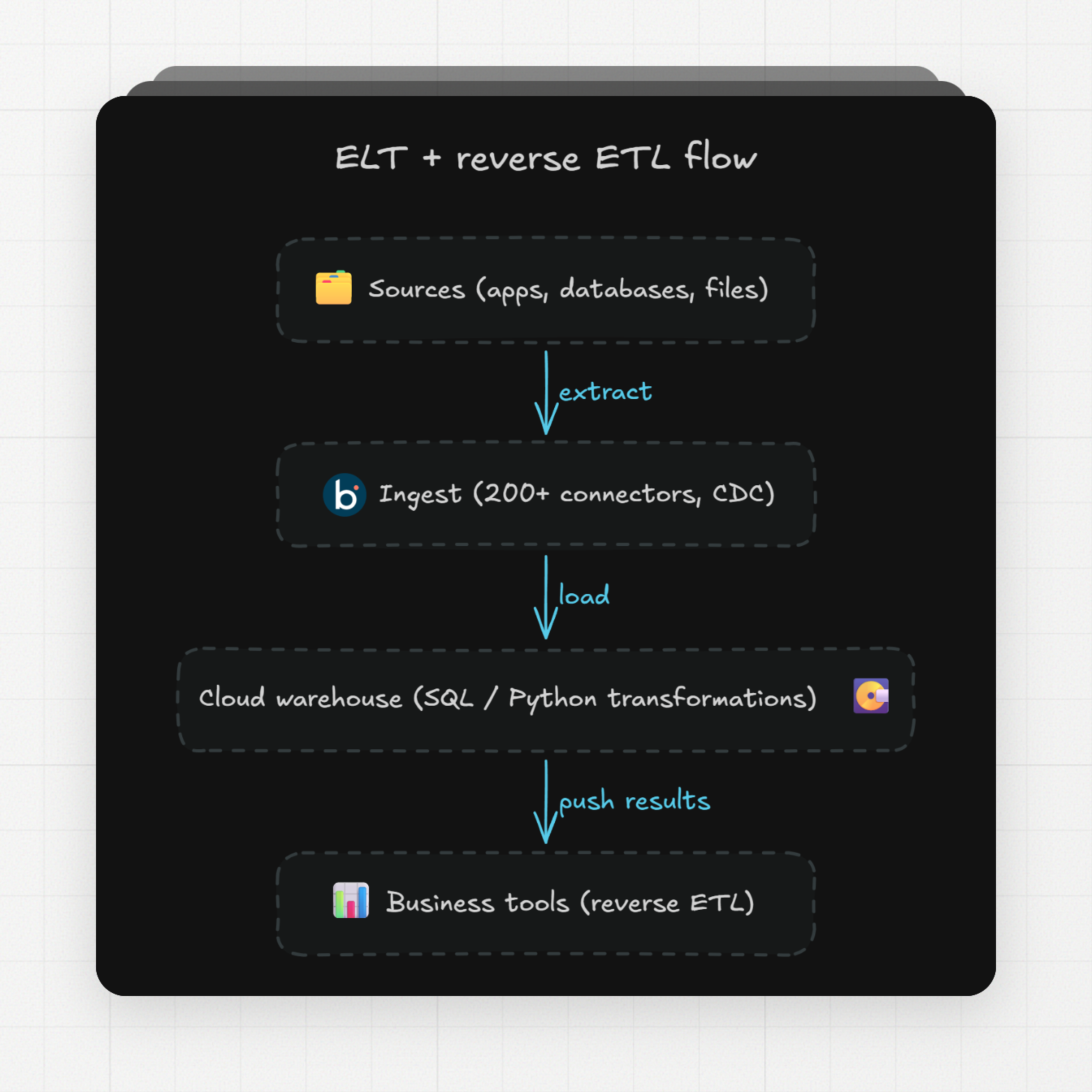
Rivery is a SaaS ELT platform that moves data from apps, databases, and files into a cloud warehouse and transforms it there with SQL or Python. In December 2024, Boomi acquired Rivery and renamed the product Boomi Data Integration.
ELT stands for extract, load, transform: the tool pulls raw data out of a source, loads it into your warehouse, and runs the transformations inside the warehouse instead of on a separate server.
The rebrand has not replaced the old site. The Rivery product page still markets "The Complete SaaS ELT Platform" under the rivery.io domain, while the about page now reads "Boomi Data Integration, formerly Rivery" and says the product is part of the Boomi Enterprise Platform. If you are evaluating Rivery in 2026, you are evaluating a Boomi product.
What happened when Boomi acquired Rivery?
Boomi announced the agreement to acquire Rivery on December 17, 2024, with terms undisclosed, and its transition page says the acquisition closed in December 2024. At the time, Rivery had over 450 customers.
Since then, the product name changed but the product itself continues. Boomi's own product page labels it "Boomi Data Integration (Rivery)" and still routes trial signups through Rivery's site. The transition page announces the rename and lists no shutdown date or migration deadline for existing Rivery accounts.
What does Boomi Data Integration (Rivery) do?
Boomi Data Integration covers five jobs in one SaaS tool: ingestion, transformation, orchestration, reverse ETL, and data operations. You connect a source, land the data in your warehouse, transform it there, and push results back out to business tools.
The main capabilities, from the current Rivery and Boomi pages:
- 200+ prebuilt connectors, plus custom connectors built from any API or webhook.
- Change data capture (CDC): instead of re-reading whole tables, the tool reads the database's change log and copies only the rows that changed.
- Multi-step SQL transformations that run inside the warehouse, with native Python for logic SQL can't express.
- Reverse ETL, which copies data from the warehouse back into business tools. Boomi's examples include enriching CRM records, sending data to Slack, and triggering a Tableau refresh.
- Kits: production-level workflow templates that bundle data models, pipelines, transformations, schemas, and orchestration logic.
How does Rivery pricing work?
Rivery charges per BDU credit. BDU stands for Boomi Data Unit, the renamed Rivery Pricing Unit (RPU), and the current rivery.io pricing page lists the Base plan at $0.9 per credit. Different pipeline types burn credits at different rates, so two teams on the same plan can pay very different bills.
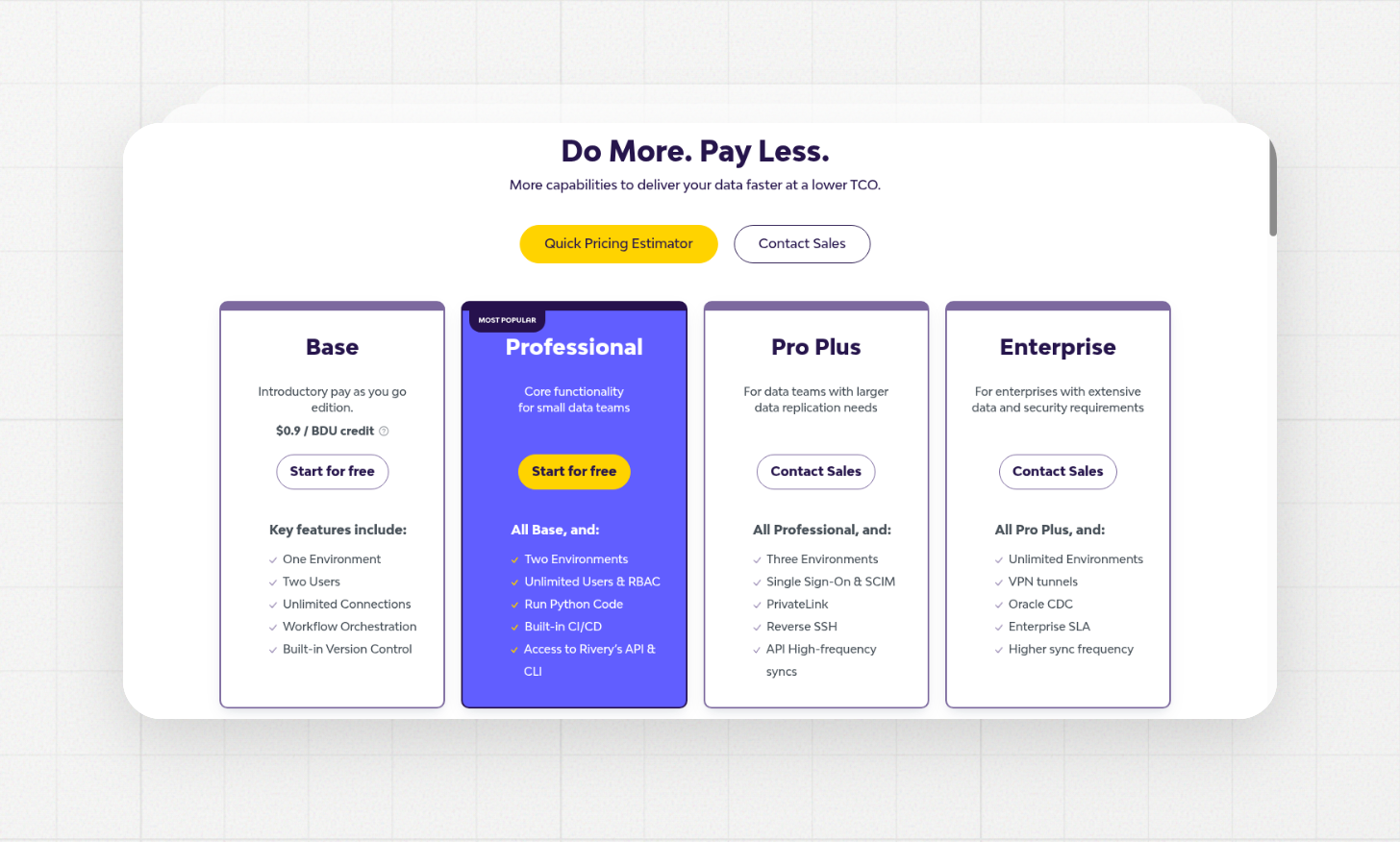
Rivery's current plan cards, with Base at $0.9 per BDU credit
The credit meter by pipeline type:
Pipeline type | Credit cost |
|---|---|
Application/API source | 0.5 credit per output table per run (default) |
High-frequency API source | 1 credit per 100MB |
Database, file storage, or webhook source | 1 credit per 100MB transferred |
Log-based CDC | 2 credits per 100MB |
Orchestration / advanced workflow run | 0.5 credit |
A quick worked example at the Base rate: replicating 100GB a month from a database is 1,000 blocks of 100MB, so 1,000 credits, or $900 a month. The same 100GB through log-based CDC costs 2,000 credits, or $1,800.
The plans differ on more than the rate. Base includes one environment, two users, and a 60-minute minimum sync frequency. Professional adds a second environment, unlimited users with role-based access control, Python, CI/CD, API/CLI access, and 15-minute syncs. Enterprise adds Oracle CDC, an enterprise SLA, and 5-minute syncs.
During evaluation, check the G2 listing for Boomi Data Integration, which displays different per-credit prices, $0.75 for a Starter tier and $1.20 for Professional. Those figures conflict with the current official page, so confirm the rate with sales before you model costs.
Is Rivery free to use?
Rivery has a free trial but no permanent free plan. The trial gives you Professional plan features for 14 days or 1,000 free credits (worth $1,200), whichever runs out first.
After the trial, the cheapest way in is the Base edition at $0.9 per credit, with the two-user, one-environment, 60-minute-sync limits above. Every pipeline run keeps consuming credits, so there is no volume you can move for free on a paid account.
What are the tradeoffs of Rivery today?
The most common complaints from G2 reviewers are connector gaps and documentation gaps. One reviewer wrote that Rivery "doesn't have all our data sources available as 'ready to use' connections", another that documentation is missing or reports lack fields they need. Reviewers also asked for friendlier error messages and said complex debugging and advanced customizations take extra time.
The pricing meter adds an evaluation cost of its own. Because API sources, database loads, and CDC are billed on different units (per run, per 100MB, or double per 100MB), estimating your bill means mapping every planned pipeline to its meter before you can compare Rivery against a flat-tier tool.
The acquisition is a third factor. The product now belongs to a large integration vendor, the brand is mid-transition across two websites, and public pages show conflicting per-credit prices. Those three factors make 2026 a reasonable time to compare alternatives before committing.
What are the best Rivery alternatives in 2026?
The main Rivery alternatives in 2026 are Erathos, Fivetran, Airbyte, Matillion, Estuary, Weld, Kondado, and Nekt. They all move data into a warehouse; the biggest practical difference is what each one charges you for.
Tool | Pricing meter | What stands out |
|---|---|---|
Monthly rows written to the warehouse; plans at $0, $29, and $250/mo | No limits on the number of connectors; batch, incremental, or CDC per pipeline; custom connector code stays in your GitHub repo | |
Monthly Active Rows (distinct rows synced, counted once per month) | Initial syncs are free; a $5 base charge applies to connections between 1 and 1M MAR | |
Volume-based on Standard; capacity-based Data Workers on Pro | Open-source core with 600+ connectors; a Data Worker typically runs about 3 syncs at once | |
Consumption credits from task hours plus extra developer users | Low-code canvas with SQL/Python; streaming CDC and hybrid deployment on the Scale tier | |
$0.50 per GB plus $100 per connector per month | Free tier with 10GB/month; millisecond latency or batch at the same price | |
Subscription tiers with included MAR, from $99/mo billed annually | Reverse ETL included across plans; CDC on Enterprise | |
Records written to destination; entry plan R$99/month for 1M records and 4 integrations | Brazil-based pricing in reais; a record is a row of up to 500 bytes | |
Credits, where one credit is one pipeline run; free plan with 40 runs/month | Failed runs don't consume credits; log-based CDC on the Growth tier |
Erathos is our platform, so here is the concrete difference from Rivery's meter: you pay for expected monthly rows written to the warehouse, with no charge per connector and no separate rates per pipeline type. A CDC pipeline and a batch pipeline count the same way. The free tier covers up to 1M rows a month, and the Pro plan at $250/mo includes CDC, API access, and 5-minute updates.
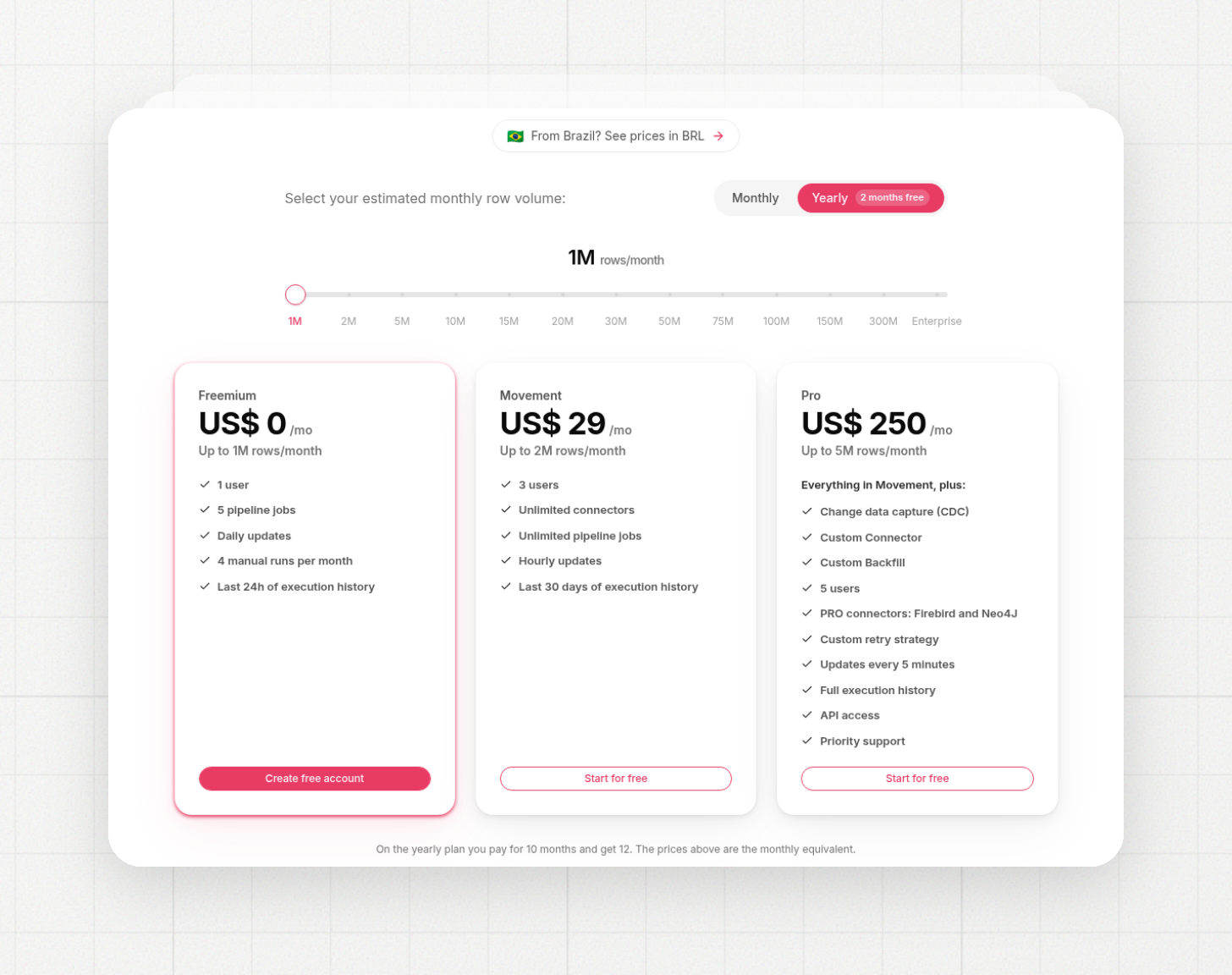
Erathos pricing tiers, metered on monthly rows written to the warehouse
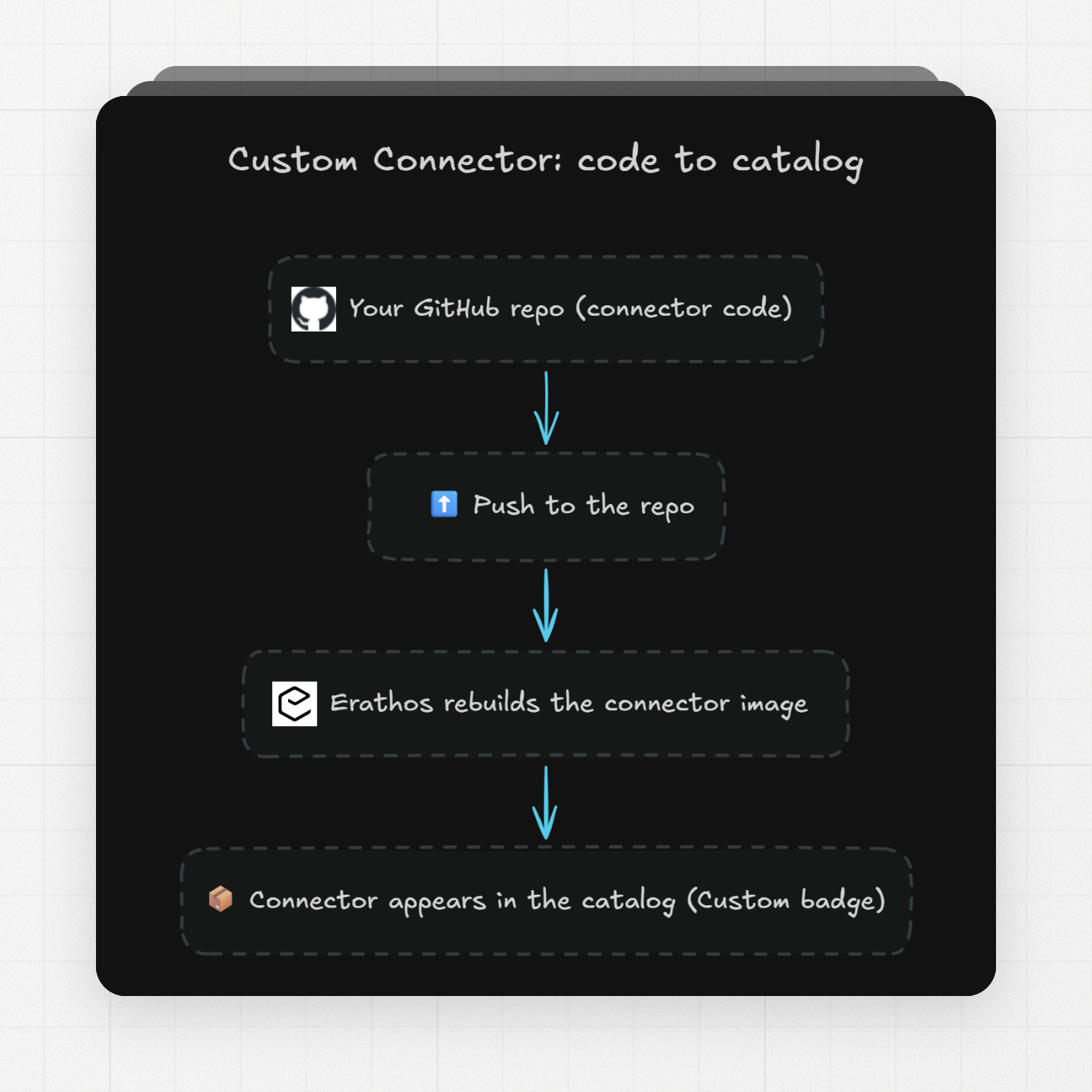
For sources without a prebuilt connector, the Custom Connector works through a GitHub App: you keep the connector code in your own repository, every push rebuilds it, and after the first build it shows up in the pipeline catalog like any built-in connector.
Which Rivery alternative fits your stack?
The fastest way to choose is to price your real workload on two or three meters, since the same pipelines cost very different amounts per tool. A checklist that covers the differences in the table:
- List your sources and destinations, and check each vendor's catalog for the ones with no prebuilt connector.
- Decide per source whether batch is enough or you need CDC, because several tools price or gate CDC separately.
- Estimate volume in each vendor's unit: rows for Erathos, MAR for Fivetran and Weld, GB for Estuary, credits for Rivery, Matillion, and Nekt.
- Check who owns custom connectors: a vendor request queue, or code you control.
- Confirm the sync frequency your dashboards need, since minimum frequency changes by plan on most of these tools.
If the goal is centralizing data into a warehouse with a small team, we wrote a practical guide to data centralization without a dedicated data engineer and a primer on how to build and manage a data pipeline that walk through the same decisions with examples.
Want to see how your pipelines price out on a row-based meter? Try Erathos free for 14 days.